

Passive Cooling: Keeping a Home Cool Without Air-Con
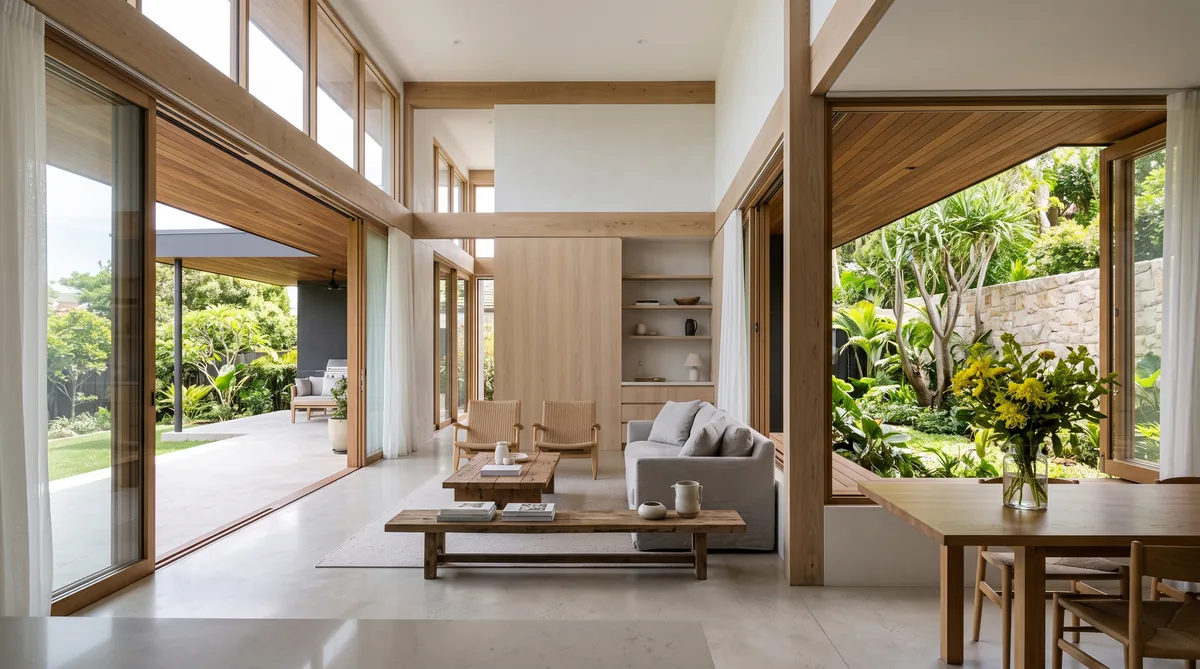
Passive cooling keeps a home comfortable in summer by stopping unwanted heat getting in and letting trapped heat out, without relying on air-conditioning. The main tools are shading sized for the high summer sun, cross ventilation and night purging to flush warm air, thermal mass to steady the temperature, and glazing chosen and placed to limit heat gain. BRANZ research and Passive House principles both treat cooling as a design decision, made on paper at the concept stage and tested against the summer sun, rather than a machine added after the home is built. Done well, the home stays comfortable on a hot day without the running cost or noise of mechanical cooling.
Key Questions Answered
What is passive cooling?
Passive cooling keeps a home cool by managing heat rather than machinery: shading out the summer sun, ventilating to flush warm air, and using thermal mass and well-chosen glazing. BRANZ and Passive House principles both design it in from the start.
Why can a well-built home overheat?
A warm, airtight, well-insulated home holds heat, which is exactly what you want in winter. In summer, if solar gain through the glazing is not managed, that same heat is trapped inside and the home overheats.
How does shading keep a home cool?
Correctly sized eaves block the high summer sun from the glass while still letting the low winter sun in. External shading on east and west faces stops the low morning and evening sun, which eaves cannot reach.
How does cross ventilation cool a home?
Openings on opposite sides let air move through and carry heat out. Opening up on cool summer nights, known as night purging, flushes the day’s warmth so the home starts the next day cooler.
How do you design cooling in?
Cooling is decided at the concept stage, tested against the path of the summer sun, using orientation, shading, ventilation, thermal mass and glazing together. It is far cheaper and more effective than adding air-conditioning later.
In This Guide
Key Takeaways
- A warm, airtight, well-insulated home can overheat in summer if solar gain through the glazing is not managed; the insulation that keeps winter heat in also keeps unwanted summer heat in.
- Shading is the first line of defence: eaves sized for the high summer sun in Nelson Tasman, and external shading on east and west faces for the low morning and evening sun.
- Cross ventilation and night purging, opening up on cool nights, flush trapped warm air so the home starts each day cooler.
- Thermal mass steadies indoor temperatures, and glazing is chosen and placed to limit unwanted heat gain, both following BRANZ guidance and Passive House principles.
- Cooling is designed on paper at the concept stage and tested against the summer sun, not added as air-conditioning after the home is built.
Why can a well-built home overheat in summer?
A well-built home can overheat in summer because the insulation and airtightness that keep it warm in winter also keep unwanted heat in once it arrives. The heat usually arrives as solar gain, sunlight striking the glass and warming the rooms behind it. If that gain is not managed, the home traps it.
This surprises people, because the same qualities that make a home comfortable in a Nelson Tasman winter are what leave it exposed in summer if the sun is not controlled. A warm, sealed, well-insulated envelope holds heat in both directions. The answer is not to build a leakier or thinner home; it is to stop the summer sun getting in and to give trapped heat a way out. BRANZ research on summer comfort makes the same point: overheating is a design issue, best solved by managing the sun and the air rather than by cooling the home after the fact. It is the flip side of the Passive House principles that keep a home warm, and it is why we solve winter and summer together, not one at a time.
How does shading keep a home cool?
Shading keeps a home cool by stopping the summer sun reaching the glass in the first place, which is far more effective than trying to remove that heat once it is inside. The key is that the summer sun is high in the sky and the winter sun is low, so shading can be tuned to block one and welcome the other.
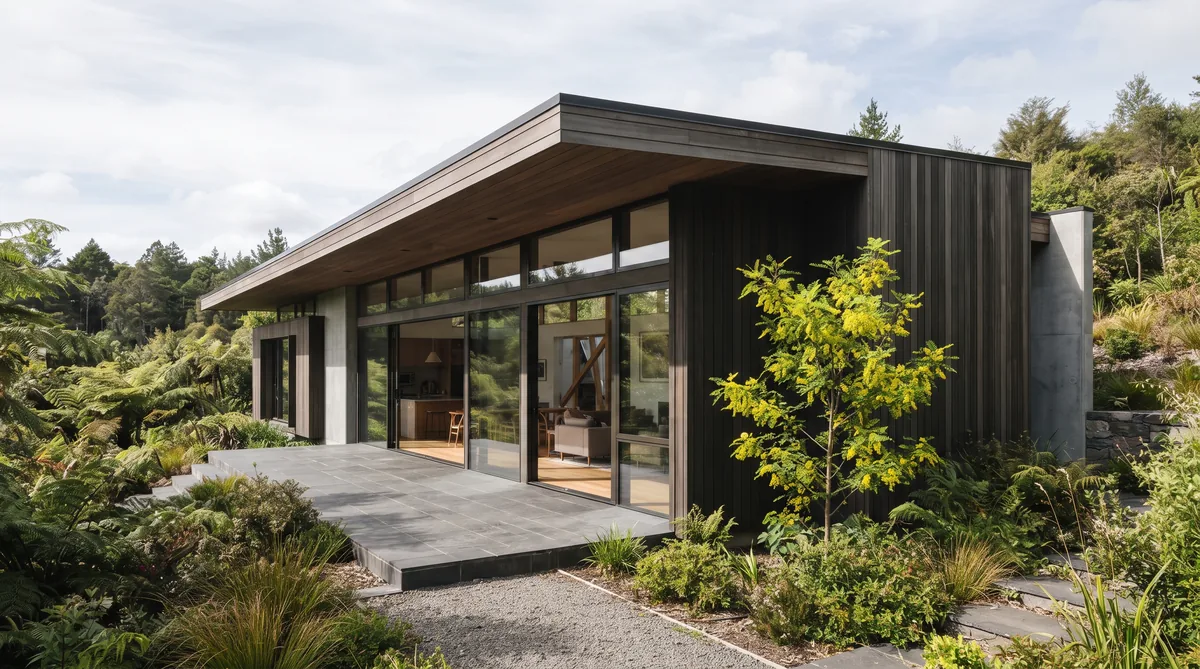
On a north-facing wall, a correctly sized eave is the simplest tool. In a Nelson Tasman summer the midday sun climbs high, so an eave of the right depth casts the glass into shade through the hottest part of the day, while the low winter sun still slips underneath to warm the rooms when you want it. That is a single detail doing two seasons of work, and it depends entirely on getting the depth right for this latitude and this sun. Our guide to designing for the Nelson Tasman sun works through how that path is mapped. Eaves cannot help the low morning and evening sun, though, which strikes east and west faces almost horizontally and slides straight under any overhang. Those faces need external shading, planting, screens, louvres or shutters that stop the heat outside the glass. Shading placed inside, behind the glass, has already let the heat in.
How does cross ventilation work?
Cross ventilation works by placing openings on opposite or adjacent sides of the home so air can move through, carrying warm air out and drawing cooler air in. It relies on a path for the air, not just a single open window, and it is at its most powerful on cool summer nights.
The most useful move is night purging: opening the home once the outside air has cooled, so the day’s warmth flushes out and cooler air sweeps through before you close up again in the morning. A considered plan places openings to make that flow easy and secure, high and low where possible, so warm air escaping up and out pulls cooler air in below. This is separate from the mechanical ventilation a high-performance home may run for air quality; night purging is about moving heat, using the free cool of a Nelson evening. It pairs naturally with an open, well-oriented layout, which is why we think about air movement alongside daylight when we plan a home, as covered in natural light and space in home design.
What roles do thermal mass and glazing play?
Thermal mass steadies indoor temperatures by absorbing heat through the day and releasing it slowly, while glazing is chosen and placed to limit unwanted solar gain. Together they smooth out the peaks, so a hot afternoon does not become a hot evening, and the glass stops being the weak point in the envelope.
Thermal mass, a concrete floor or a solid internal wall, acts like a flywheel for temperature. It soaks up warmth during the day, keeping rooms cooler, then gives that heat up to the cool night air when you purge, ready to do the same again. Glazing is the other half of the equation. Modern high-performance glass can be specified to let daylight through while reflecting much of the sun’s heat, and its placement matters as much as its make-up: generous where shading protects it, restrained on unshaded east and west faces. The trade-offs between glass types, and how they balance winter warmth against summer heat, are set out in our guide to double versus triple glazing. The table below summarises how each strategy earns its place.
| Strategy | How it cools the home |
|---|---|
| Shading | Stops the high summer sun and the low east and west sun reaching the glass, so the heat never gets inside |
| Cross ventilation | Moves air through the home and, with night purging, flushes the day’s trapped warmth out on cool evenings |
| Thermal mass | Absorbs heat slowly through the day and releases it at night, steadying indoor temperatures and softening the peaks |
| Glazing | Chosen and placed to let daylight in while limiting unwanted solar gain, especially on unshaded faces |
How do you design cooling in from the start?
You design cooling in by settling orientation, shading, ventilation, thermal mass and glazing together at the concept stage, then testing the design against the path of the summer sun before anything is built. On paper these decisions are almost free to change; on site they are expensive or impossible.
This is the heart of the matter. Air-conditioning added later is a machine compensating for a design that let the heat in, with a running cost and a lifespan attached. A home that shades its glass, moves its air and holds steady with thermal mass rarely needs that machine, because the comfort is built into the fabric. Passive House principles model summer overheating alongside winter warmth, so the two seasons are balanced from the first sketch rather than traded against each other. This is exactly the kind of question we solve early, with the right architect, an energy-literate engineer and, where it is useful, an energy consultant, in the approach we call Around One Table, so the sun is designed for while the drawings are still cheap to change. You can see how that whole approach comes together on our design and build page.
What is the bottom line?
A home stays cool in a Nelson Tasman summer when the summer sun is shaded out, warm air is flushed through on cool nights, thermal mass steadies the temperature and the glazing is chosen to limit heat gain. Those strategies work as a set, and they belong in the design from the first concept, not in a machine bolted on afterwards.
Both BRANZ research and Passive House principles treat summer comfort as a design decision, tested against the sun on paper while it is still easy to get right. That is how we approach every home: winter and summer solved together, so the house is comfortable through the year without leaning on air-conditioning. If you are thinking about a home that stays cool without the running cost, the best first step is to arrange a consultation while the design is still on the drawing board.
Frequently Asked Questions
Does a Passive Home need air-conditioning in summer?
Usually not, if it is designed well. Passive House principles model summer comfort alongside winter, so shading, ventilation and glazing are set to limit overheating. BRANZ research shows good passive design keeps most New Zealand homes comfortable through summer without mechanical cooling. Air-conditioning becomes a fallback for extremes, not a daily crutch.
Why does my insulated home get so hot in summer?
Insulation slows heat moving in both directions. In winter it keeps warmth in; in summer, once heat from the sun gets inside through unshaded glass, the same insulation keeps it there. The fix is not less insulation but better shading and ventilation, so the heat never gets in and can escape at night.
What is night purging?
Night purging means opening the home on cool summer nights to let the day’s trapped heat flush out and cooler air move in, often across the home through openings on opposite sides. It works best paired with thermal mass, which soaks up warmth during the day and gives it up to the night air, so the home starts the next day cooler.
Do eaves really make a difference?
Yes, when they are sized to the sun. In a Nelson Tasman summer the midday sun is high, so a correctly sized eave shades north-facing glass from that heat while still letting the low winter sun stream in. Eaves cannot help with the low east and west sun, though, which is why external shading matters on those faces.
Can I add passive cooling to an existing home?
Some of it. External shading, planting and better ventilation can be retrofitted, and they help. The most effective measures, orientation, glazing placement and thermal mass, are set by the design, which is why cooling is far cheaper and more effective to solve at the concept stage than to patch later.
Is passive cooling enough on the hottest days?
For most summer days in Nelson Tasman, a well-designed home stays comfortable on passive measures alone. On the rare extreme day, a well-shaded, well-ventilated home still needs far less mechanical help than a home that relies on air-conditioning to cover for poor solar design. The design does the heavy lifting; any machinery only tops it up.
Research Report: Passive Cooling in New Zealand Homes
Read Full ReportWhy well-built homes can overheat, and how shading, cross ventilation, thermal mass and glazing keep a home cool without air-conditioning.
Planning a build in Nelson Tasman?
Talk to Ecotectural early and keep control of your design and budget from day one.
Arrange a consultation