

What Is a Certified Passive House, and How Is It Different in NZ?
A certified Passive House is a home that has been independently verified to meet the international Passive House standard, administered in New Zealand by PHINZ and awarded by the Passive House Institute. It must hit measured targets for heating energy, airtightness and comfort, proven by energy modelling and an on-site airtightness test. The key thing to understand is that building to the Passive House standard and holding formal certification are two different things: a home can be designed and built to the standard without paying for the independent certification. Certified or not, the standard is what delivers a warm, dry, low-energy home, well beyond what the Building Code minimum requires.
Key Questions Answered
What is a certified Passive House?
A home independently verified to the international Passive House standard, administered in NZ by PHINZ. It must meet measured targets for heating energy, airtightness and comfort, proven by modelling and an on-site test (Passive House standard).
Who certifies it?
The Passive House Institute awards certification, with PHINZ administering the standard in New Zealand. A home is assessed against the targets and verified before it can be called a certified Passive House.
Is building to the standard the same as being certified?
No. A home can be designed and built to the Passive House standard without paying for formal certification. Certification is the independent verification step, and it is optional and separately paid for.
How is it different from the Building Code?
The Building Code is the legal minimum, which the SuperHome Movement notes sits well behind comparable countries. The Passive House standard is a measured performance standard far above that minimum.
How is it different from Homestar?
They are complementary. Homestar rates a home’s overall sustainability across many areas, while Passive House targets measured energy and comfort. A Passive House gains many Homestar points (PHINZ).
In This Guide
Key Takeaways
- A certified Passive House is independently verified to the international Passive House standard, administered in NZ by PHINZ and awarded by the Passive House Institute.
- It must meet measured targets, including very low space heating demand and 0.6 air changes per hour at 50 pascals on a blower-door test (Passive House standard).
- Building to the Passive House standard and holding formal certification are different: a home can be built to the standard without paying for certification.
- The Passive House standard sits far above the NZ Building Code minimum, which the SuperHome Movement notes lags comparable countries.
- Passive House and Homestar are complementary, not rivals; a Passive House earns many Homestar points (PHINZ).
What is a certified Passive House?
A certified Passive House is a home that has been independently verified to meet the international Passive House standard. The standard is administered in New Zealand by PHINZ, and certification is awarded by the Passive House Institute after the home is assessed against a set of measured performance targets.
The word certified matters. It means an independent body has checked the design and the finished build against the targets, rather than the builder simply claiming the home performs. A certified Passive House is not a style or a brand. It is a measured promise about how the home performs, backed by verification.
What are the performance targets?
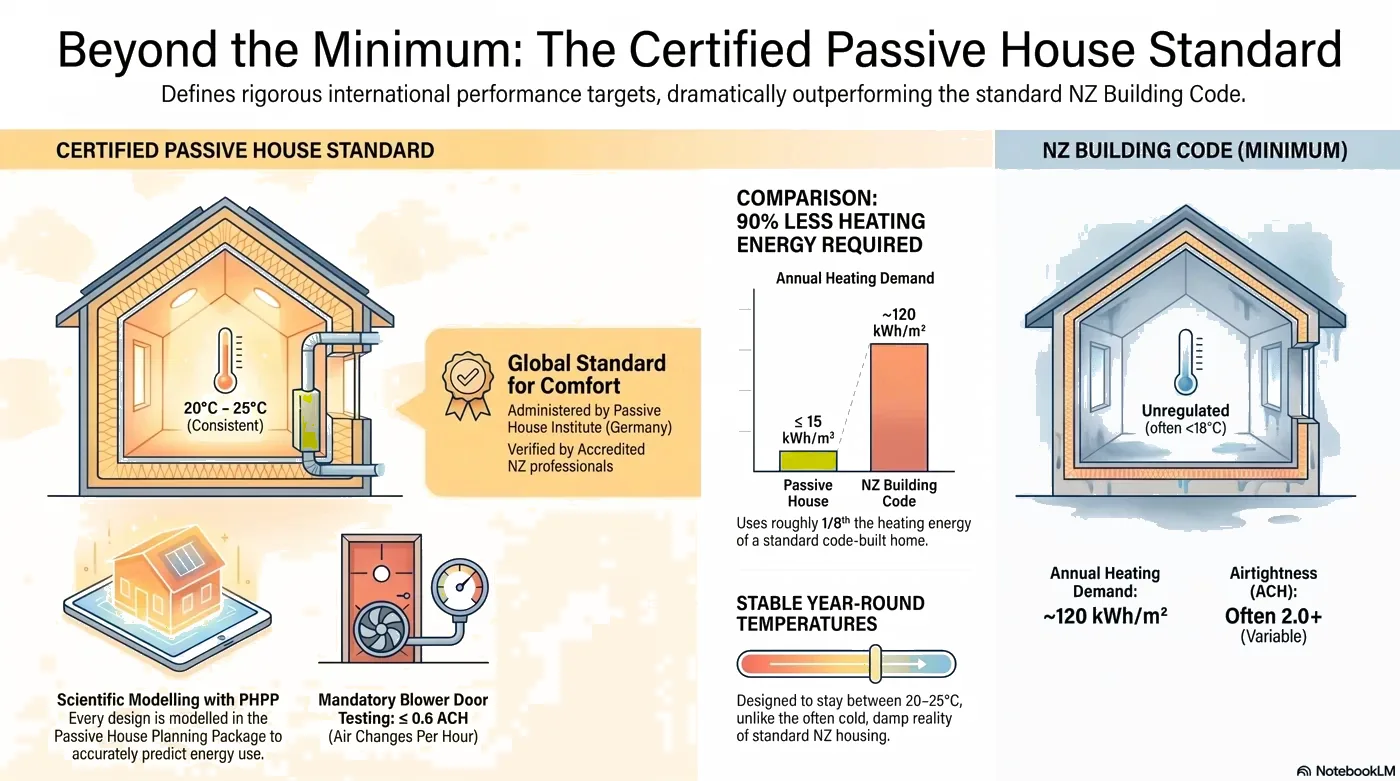
The Passive House standard sets measured targets, not vague aims. A certified Passive House Classic must keep annual space heating demand very low, around 15 kWh per square metre per year, and reach 0.6 air changes per hour at 50 pascals on a blower-door test, while holding stable, comfortable indoor temperatures year round (Passive House standard).
Those numbers are what separate the standard from a marketing claim. They are predicted before the build and tested after it, so the home has to actually perform, not just look the part. The table below shows how that compares to the alternatives.
| Factor | NZ Building Code minimum | Homestar (NZGBC) | Certified Passive House |
|---|---|---|---|
| What it measures | Legal minimum compliance | Holistic sustainability (6 to 10 stars) | Measured energy and comfort |
| Airtightness | Not tested | Tested at higher star levels | 0.6 ACH at 50 Pa, always tested |
| Heating energy | No hard limit | Improved | Very low, around 15 kWh/m²/yr |
| Verification | Council inspections | Independent assessment | PHPP modelling + on-site test |
| Who certifies | Council (consent) | NZGBC | Passive House Institute (PHINZ in NZ) |
How is a Passive House certified?
Certification is a process, not a sticker. The design is first modelled in the Passive House Planning Package (PHPP), which predicts the home’s energy use and confirms it can meet the targets. The build is then detailed to match the model, and the finished home is tested on site, including the blower-door airtightness test, before certification is granted.
There are tiers, too. The main certified levels are Classic, Plus and Premium, which differ on renewable energy and primary energy use, and there is EnerPHit, a slightly relaxed version of the standard for retrofitting existing buildings. For most new homes, Classic is the reference point. To understand the building science behind the targets, see the five principles of a Passive House.
Built to the standard versus certified: what is the difference?
This is the part most people miss. Building to the Passive House standard and holding formal certification are two different things. A home can be designed and built to the standard, using the same insulation, airtightness, glazing and ventilation, without paying for the independent certification at the end.
Certification is the optional verification step. It gives you independent, documented proof that the home meets the targets, which some owners value for resale, peace of mind, or simply to know it was done right. It also adds cost and process. The important point is that the warmth, dryness and low running costs come from building to the standard, not from the certificate itself. Deciding whether to certify is a choice to make with your builder, weighed against the value the proof adds for you.
How is it different from the Building Code and Homestar?
The Building Code is the legal minimum. The SuperHome Movement points out that this minimum sits well behind comparable countries, so a home built to the Code alone is built to the lowest standard the law allows. The Passive House standard is a measured performance standard that sits far above that minimum.
Homestar is a different tool again. Run by the New Zealand Green Building Council, it is a holistic 6 to 10 star rating across energy, health, water, materials and more. Passive House and Homestar are complementary rather than rival: Passive House targets measured energy and comfort, and a certified Passive House gains many Homestar points (PHINZ). If you are weighing the schemes against each other, our guide comparing why NZ homes underperform shows what the standards are really solving for.
What is the bottom line?
A certified Passive House is a home independently verified to the international Passive House standard, administered in New Zealand by PHINZ. It has to meet measured targets for heating energy, airtightness and comfort, proven by modelling and an on-site test, which is what lifts it far above the Building Code minimum.
The distinction worth remembering is that building to the standard delivers the performance, while certification adds independent proof and is an optional, separate choice. Ecotectural builds Passive Homes, and whether a particular home is formally certified is a decision made with the client. If you are planning a high-performance home in Nelson Tasman, the best first step is to arrange a consultation before the design is locked in.
Frequently Asked Questions
What targets must a Passive House meet?
A certified Passive House Classic must keep annual space heating demand very low (around 15 kWh per square metre per year) and reach 0.6 air changes per hour at 50 pascals on a blower-door test, while holding comfortable, stable indoor temperatures (Passive House standard).
How is a Passive House verified?
The design is modelled in the Passive House Planning Package (PHPP) to predict its energy use, the build is detailed to match, and the finished home is tested on site, including the blower-door airtightness test, before certification is granted.
Are there different Passive House levels?
Yes. The main tiers are Classic, Plus and Premium, which differ on renewable energy and primary energy. There is also EnerPHit, a slightly relaxed standard for retrofitting existing buildings.
Do you have to certify to get the benefits?
No. The warmth, dryness and low running costs come from building to the standard, not from the certificate. Certification adds independent proof, which some owners value for resale or peace of mind, and it is an optional, separate cost.
Is a Passive House the same as a Homestar home?
No, they measure different things and work well together. Homestar (NZGBC) is a holistic 6 to 10 star sustainability rating; Passive House targets measured energy and comfort. A certified Passive House gains many Homestar points (PHINZ).
Does Ecotectural build Passive Homes?
Yes. Ecotectural builds Passive Homes, combining continuous insulation, airtightness, high-performance glazing and heat recovery ventilation. Whether or not a particular home is formally certified is a choice made with the client.
Research Report: Certified Passive House in New Zealand
Read Full ReportWhat the standard requires, how certification works, and how it compares to the Building Code and Homestar.
How Ecotectural Can Help
Services and systems related to this guide
Planning a build in Nelson Tasman?
Talk to Ecotectural early and keep control of your design and budget from day one.
Arrange a consultation