

Open-Book vs Fixed-Price Building Contracts in NZ: A Plain-English Guide
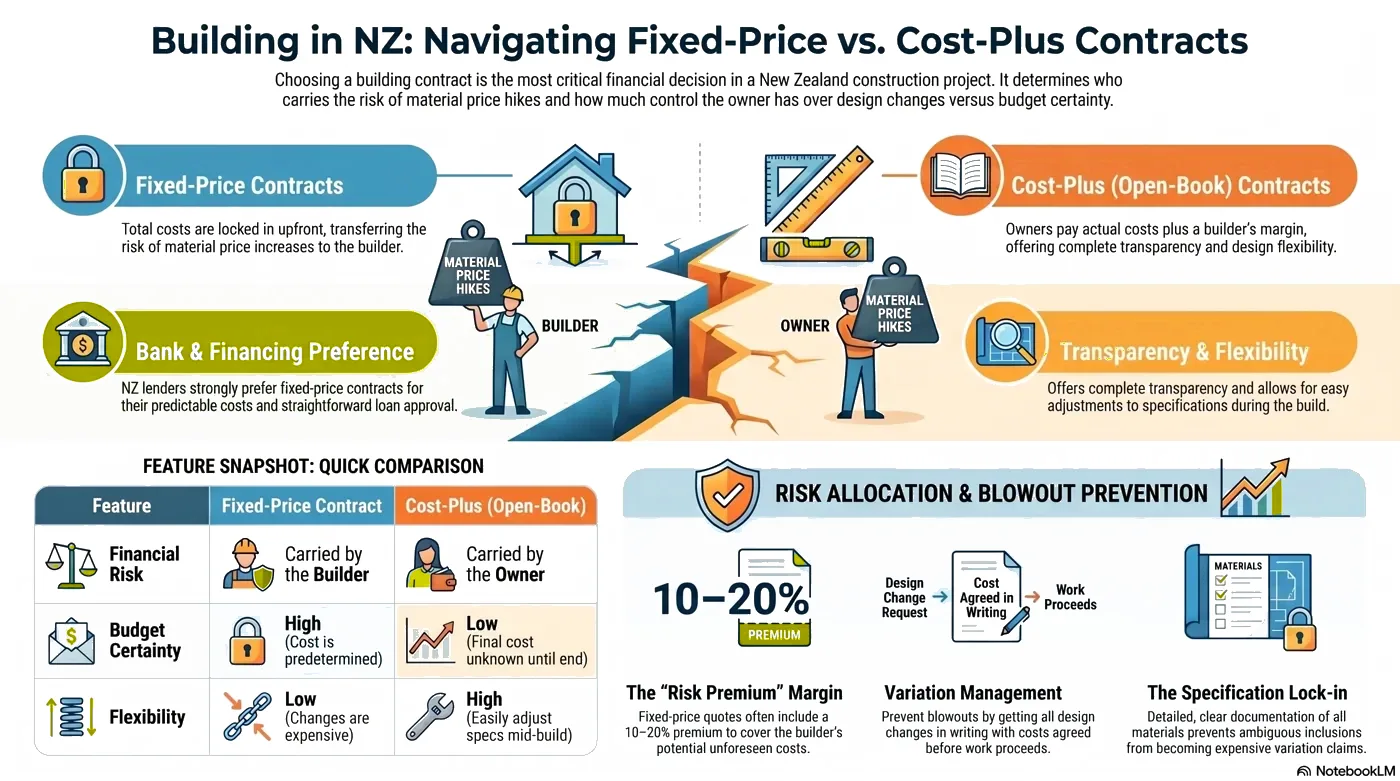
A fixed-price contract gives you price certainty, but the builder adds a risk premium of about 10 to 20 percent to cover the unknowns. A cost-plus contract is cheaper on paper but you carry the risk of a blowout. An open-book contract is a transparent form of cost-plus where you see every labour timesheet and supplier invoice, so you pay the real cost with no hidden margin and keep control of the budget. For a bespoke architectural home, open-book with strong project management usually gives the best mix of value and control.
Key Questions Answered
What is the difference between fixed-price and cost-plus?
Fixed-price locks one total price and the builder carries the cost risk, adding a premium for it. Cost-plus means you pay actual costs plus a fee, so you carry the risk but avoid the premium (Mortgage Lab).
What does open-book pricing actually mean?
Open-book is cost-plus with full transparency: you see every labour timesheet, material invoice and subtrade invoice with supplier copies, so you know exactly what you are charged (Outside Accounting).
Is fixed-price really the safe option?
Not entirely. Fixed-price feels safe but carries a built-in risk premium of roughly 10 to 20 percent, and variations during the build can still change the price (Luminate).
Which contract keeps me in control of the budget?
Open-book, paired with complete project management, gives the most control: you see real costs as they happen and can make informed decisions before money is spent, rather than after.
In This Guide
- What are the three main building contract types in NZ?
- How does a fixed-price contract actually work?
- How does cost-plus work, and what is the risk?
- What is open-book pricing, and how is it different?
- How do the three contracts compare side by side?
- Which contract protects you on a high-end build?
- What is the bottom line?
Key Takeaways
- Fixed-price contracts carry a builder risk premium of roughly 10 to 20 percent to cover the unknowns (Luminate).
- Cost-plus removes that premium but shifts the risk of a blowout onto you, which is why transparency matters so much.
- Open-book is cost-plus with full transparency: fortnightly labour timesheets and monthly material and subtrade invoices with supplier copies (Outside Accounting).
- Engaging your builder early, before the design is locked in, is the single biggest lever for avoiding the over-budget tender trap (NB Architects).
- The contract type matters less than the transparency and project management behind it; honest billing plus one accountable team is what protects your budget.
What are the three main building contract types in NZ?
New Zealand residential builds usually run on one of three contract types: fixed-price, cost-plus, or open-book. The difference comes down to two things: how certain the price is, and who carries the risk when reality does not match the plan.
Fixed-price gives you one total number and puts the risk on the builder. Cost-plus charges you the actual cost plus a fee and puts the risk on you. Open-book is a transparent version of cost-plus that shows you every dollar. For a bespoke architectural home, the right answer is rarely the cheapest-looking option, it is the one that keeps you informed and in control.
How does a fixed-price contract actually work?
A fixed-price contract locks in one lump sum for the whole build. It feels safe because you know the number up front, and banks tend to prefer it for lending.
The catch is the risk premium. Because the builder carries the cost of every unknown, from timber price rises to difficult ground, they price in a contingency to protect themselves. That premium is commonly around 10 to 20 percent, and you pay it whether or not those risks ever happen (Luminate). Fixed-price also does not make the price immovable: variations and changes during the build still adjust the total, often at rates set in the builder’s favour. It buys certainty, but you pay for certainty you may not need.
How does cost-plus work, and what is the risk?
Cost-plus means you pay the actual cost of labour and materials, plus an agreed fee or percentage for the builder. With no risk premium baked in, it can deliver a home for less than a fixed-price equivalent.
The risk is that you carry the uncertainty. If costs run over, that is your problem, and without transparency it is hard to know whether they should have. This is the source of the cost-plus horror stories: homeowners describing a final bill arriving tens of thousands of dollars over expectation, or being told an extra sum is simply needed near the end. The model is not the villain. The lack of visibility and management is. Cost-plus done in the dark is a gamble; cost-plus done in the open is one of the fairest ways to build.
What is open-book pricing, and how is it different?
Open-book pricing is cost-plus with the books open. You pay the real cost of the build plus an agreed fee, and you see exactly what that cost is, line by line, as it happens (Outside Accounting).
At Ecotectural that means fortnightly labour invoices with timesheets, and monthly materials and subtrade invoices with supplier copies attached. You are not trusting a number, you are seeing the evidence behind it. There is no hidden margin on materials and no contingency premium for risks that never occur. Because the costs are visible while decisions are still open, you can choose where to invest and where to save before the money is committed, not after. That is the difference between being billed and being in control.
How do the three contracts compare side by side?
The table below sums up how the three contract types handle price, risk and transparency. The right choice depends on how much certainty you need and how much visibility you want.
| Factor | Fixed-price | Cost-plus | Open-book |
|---|---|---|---|
| Price certainty | High (one lump sum) | Low | Medium (target budget, real costs visible) |
| Who carries the risk | Builder | Homeowner | Shared, with full visibility |
| Risk premium | ~10 to 20% added (Luminate) | None | None |
| Transparency | Low (margin hidden in the price) | Varies | High (timesheets + supplier-copy invoices) |
| Best for | Simple, well-defined builds | Trusted builder, flexible budget | Bespoke architectural homes where control matters |
For a one-off, fully specified build, fixed-price can make sense. For a bespoke architectural home, where the design evolves and quality decisions matter, open-book keeps you informed at every step.
Which contract protects you on a high-end build?
On a bespoke build, the contract type matters less than the transparency and project management behind it. The biggest budget risk on a high-end home is not the contract, it is the over-budget tender trap: a design developed in isolation, then sent to builders, that comes back too expensive and forces costly redesigns (NB Architects).
The way to avoid that is to engage your builder early, before the design is locked in, so the home is costed as it is designed. Pair that with open-book pricing so you see real costs as they happen, and complete project management so one accountable team coordinates every trade. That combination, not a single signature on a fixed-price contract, is what actually protects your budget. It is the heart of Ecotectural’s design and build approach.
What is the bottom line?
Fixed-price buys certainty at a premium of roughly 10 to 20 percent. Cost-plus removes the premium but shifts the risk to you. Open-book gives you the fair cost of a cost-plus model with the transparency to stay in control, which is why it suits bespoke architectural homes best.
Whatever the label, what protects your budget is transparency and management: open books, an early-engaged builder, and one team accountable for the whole build. If you are planning a home in Nelson Tasman and want to understand exactly where your money goes, the best first step is to arrange a consultation before the design is locked in.
Frequently Asked Questions
What are the main building contract types in New Zealand?
The three you will meet most often are fixed-price (lump sum), cost-plus (actual cost plus a fee or percentage), and open-book, which is a transparent form of cost-plus. Each handles price certainty and risk differently.
Why do builders add a premium to fixed-price contracts?
Because the builder carries the risk of every unknown, from material price rises to ground conditions. To protect themselves they price in a contingency, often around 10 to 20 percent, which you pay whether or not those risks occur (Luminate).
Is cost-plus dangerous?
Cost-plus is only as safe as its transparency and management. Without open books and active project management, homeowners can face large surprises, which is the source of the cost-plus horror stories you read online. With open books, the same model becomes one of the fairest ways to build.
How do I avoid a building cost blowout?
Engage your builder early so the design is costed as it develops, insist on open-book transparency so you see real costs in real time, and use one team that manages every trade. Blowouts usually come from late design changes, hidden margins and poor coordination, not bad luck.
What does Ecotectural use?
Ecotectural builds on open-book pricing: fortnightly labour invoices with timesheets, and monthly materials and subtrade invoices with supplier copies. Combined with complete project management, it keeps clients in control of both design and budget from day one.
Does open-book mean there is no fixed budget?
No. You still set a target budget and design to it. Open-book means the way you reach that budget is visible: you see the real costs as they are committed, so decisions are made with full information rather than after the fact.
Research Report: Construction Pricing & Procurement in New Zealand
Read Full ReportHow fixed-price, cost-plus and open-book models allocate risk, plus design-build vs traditional paths.
How Ecotectural Can Help
Services and systems related to this guide
Planning a build in Nelson Tasman?
Talk to Ecotectural early and keep control of your design and budget from day one.
Arrange a consultation