

Passive House vs Homestar vs SuperHome: Which Standard Is Right for You?

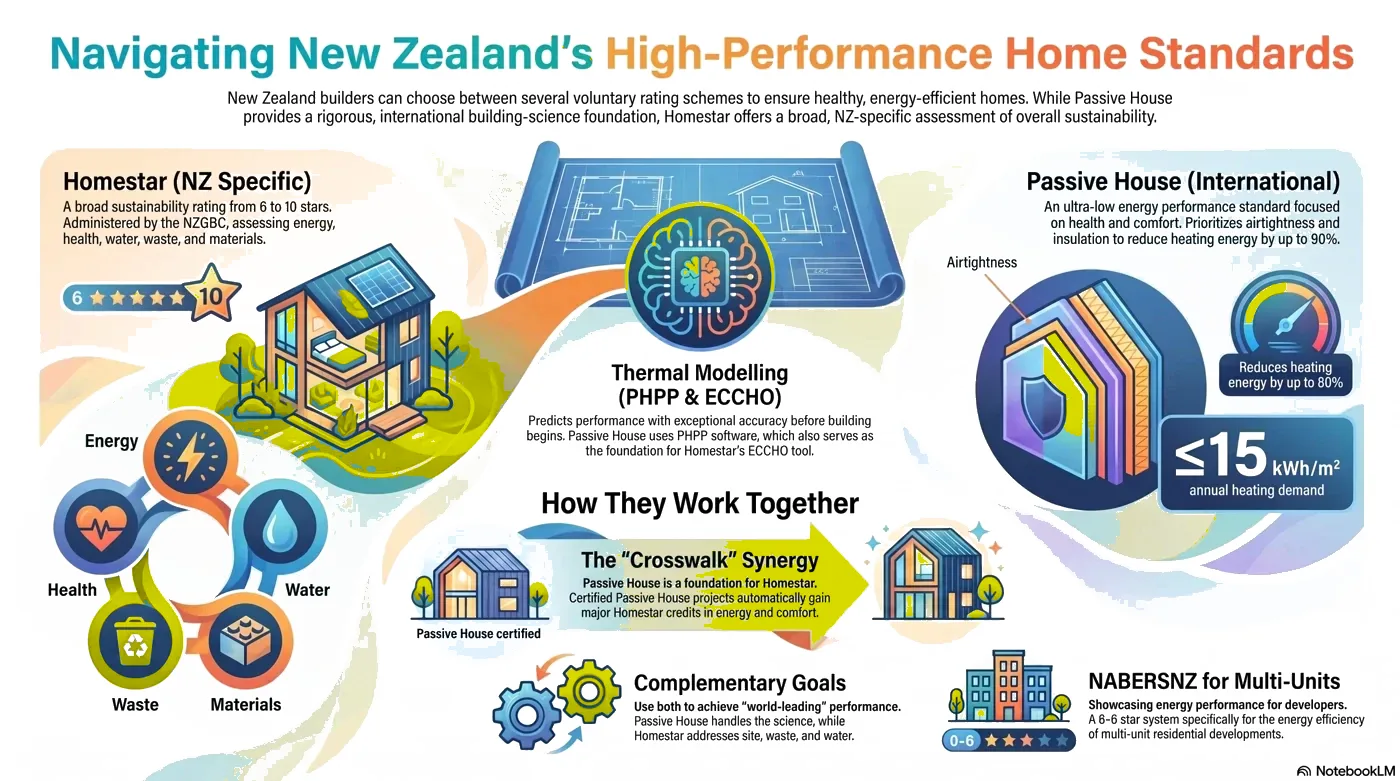
These three are not rivals; they measure different things and work well together. Passive House is an international performance standard, administered in New Zealand by PHINZ, that targets measured energy use and comfort. Homestar, run by the New Zealand Green Building Council, is a holistic 6 to 10 star rating across energy, health, water, materials and more. SuperHome is a movement and a set of better-than-Code building practices, championed by builders and designers rather than a certification you apply for. For most people building a warm, dry, low-energy home, the question is less which one to pick and more how to combine them: a home built to Passive House principles also scores well on Homestar and sits comfortably within the SuperHome philosophy.
Key Questions Answered
What is the difference between the three?
Passive House is a measured energy and comfort standard (PHINZ). Homestar is a holistic 6 to 10 star sustainability rating (NZGBC). SuperHome is a movement promoting better-than-Code building, not a formal certification.
Are they rivals?
No, they are complementary. A home built to Passive House principles also earns many Homestar points (PHINZ) and aligns with the SuperHome philosophy. You can use more than one.
Which is strictest on energy and comfort?
Passive House. It sets hard measured targets for heating energy and airtightness, verified by modelling and an on-site test, the most rigorous of the three on energy and comfort.
Which is best for overall sustainability?
Homestar, because it rates a home across energy, health, water, waste, materials, site and management, not just energy, giving a broader picture of sustainability.
What is SuperHome, exactly?
The SuperHome Movement is a group of builders, designers and owners promoting healthy, efficient, better-than-Code homes. It is a philosophy and community rather than a certification you apply for.
In This Guide
Key Takeaways
- Passive House (PHINZ) is a measured energy and comfort standard; Homestar (NZGBC) is a holistic 6 to 10 star sustainability rating; SuperHome is a better-than-Code movement, not a certification.
- They are complementary, not rivals: a Passive House earns many Homestar points (PHINZ).
- Passive House is the most rigorous on measured energy and comfort, with hard targets verified on site.
- Homestar gives the broadest view of sustainability, covering energy, health, water, materials and more.
- All three aim to beat the NZ Building Code minimum, which the SuperHome Movement notes sits well behind comparable countries.
Passive House vs Homestar vs SuperHome: what is the difference?
The three are often spoken about as if you must choose one, but they do different jobs. Passive House is a measured performance standard for energy and comfort. Homestar is a holistic sustainability rating. SuperHome is a movement promoting better-than-Code building. The table below sets them side by side.
| Factor | Passive House | Homestar | SuperHome |
|---|---|---|---|
| What it is | International performance standard | Sustainability rating (6 to 10 stars) | Movement + better-than-Code practice |
| What it measures | Measured energy and comfort | Energy, health, water, materials, site | Healthy, efficient building principles |
| Who runs it | Passive House Institute (PHINZ in NZ) | NZ Green Building Council | The SuperHome Movement |
| Certification | Yes, independently verified | Yes, a star rating | No, a philosophy not a certificate |
| Best for | The warmest, driest, lowest-energy home | A broad, recognised sustainability rating | Building well above Code, community and learning |
The honest takeaway from the table is that these are complementary tools, not competitors. The real question is how to combine them for your home.
What is Passive House?
Passive House is an international building standard, administered in New Zealand by PHINZ, that sets measured targets for energy use, airtightness and comfort. It is the most rigorous of the three on how a home actually performs day to day.
A home built to the standard uses very little energy to stay warm and dry, because it combines continuous insulation, airtightness, high-performance glazing and mechanical ventilation with heat recovery. The performance is predicted with energy modelling and verified on site, so it is a measured promise rather than a marketing claim. For the detail of how it works, see the five principles of a Passive House and our explainer on what a certified Passive House is.
What is Homestar?
Homestar is a holistic home sustainability rating run by the New Zealand Green Building Council. It scores a home from 6 to 10 stars across energy, health, water, waste, materials, site and management, giving a broad picture of how sustainable the whole home is.
Because it covers more than energy, Homestar answers a different question than Passive House. Where Passive House asks how little energy the home uses and how comfortable it is, Homestar asks how sustainable the home is overall. The two pair naturally: a home built to the Passive House standard scores strongly on the energy and comfort parts of Homestar, and a certified Passive House gains many Homestar points (PHINZ).
What is SuperHome?
The SuperHome Movement is a New Zealand advocacy group of builders, designers, researchers and owners who promote healthy, efficient, better-than-Code homes. It is a philosophy, a knowledge base and a community, rather than a certification you apply for.
SuperHome makes the case that the Building Code is a floor, not a target, and that it sits well behind comparable countries. Its role is to lift the whole industry above that minimum, sharing the building science that makes homes warm, dry and efficient. You do not get a SuperHome certificate; you build to SuperHome principles, which align closely with both Passive House and Homestar.
How do they overlap and work together?
They reinforce each other. The SuperHome philosophy says build well above Code. Passive House gives a rigorous, measured way to do that for energy and comfort. Homestar provides a broad, recognised rating that a high-performance home scores well on. None of them cancels out the others.
In practice, a single home can follow SuperHome principles, be built to the Passive House standard, and earn a strong Homestar rating, all at once. That is why framing it as a contest misses the point. The building science underneath, continuous insulation, airtightness, good glazing and heat recovery ventilation, is the same. The standards are just different ways of describing, measuring and proving it.
Which is right for you?
Start with your goal. If you want the warmest, driest, lowest-energy home and a measured guarantee of comfort, the Passive House standard is the strongest choice. If you want a broad, recognised rating of the home’s overall sustainability, add Homestar. If you simply want a home built well above the Code minimum with the best current building science, the SuperHome philosophy underpins both.
For most Ecotectural clients building a long-term home in Nelson Tasman, the practical answer is to build to the Passive House standard for the performance, and decide separately whether formal certification or a Homestar rating adds enough value to be worth the extra step. To weigh that up, see whether a Passive House is worth it.
What is the bottom line?
Passive House, Homestar and SuperHome are not competitors. Passive House is a measured energy and comfort standard (PHINZ), Homestar is a holistic sustainability rating (NZGBC), and SuperHome is a better-than-Code movement. They are designed to coexist, and a high-performance home can satisfy all three.
The smart approach is to build to high-performance principles first, then choose which standards to formally pursue based on what proof and recognition you value. Ecotectural builds Passive Homes, with the same principles that align with Homestar and SuperHome. If you are planning a home in Nelson Tasman, the best first step is to arrange a consultation before the design is locked in.
Frequently Asked Questions
Can a home have more than one of these?
Yes, and many do. A home can be built to the Passive House standard and also be rated under Homestar, and follow SuperHome principles throughout. They are designed to coexist rather than compete (PHINZ).
Is SuperHome a certification?
No. The SuperHome Movement is an advocacy group and a body of better-than-Code building knowledge, not a certificate you apply for. You build to SuperHome principles; you do not get a SuperHome certificate the way you do with Passive House or Homestar.
Does Homestar measure energy like Passive House?
It includes energy, but as one part of a broader rating. Passive House targets measured energy and comfort specifically and strictly, while Homestar scores energy alongside health, water, materials and more (Formance).
Which should I choose for a Nelson Tasman home?
It depends on your goals. For the warmest, driest, lowest-energy home, build to the Passive House standard. For a broad, recognised sustainability rating, add Homestar. SuperHome principles underpin both. Many high-performance homes use a combination.
Do I have to formally certify to benefit?
No. The comfort, health and running-cost benefits come from building to high-performance principles, not from the certificate. Certification or a Homestar rating adds independent proof, which is an optional, separate choice.
Does Ecotectural build to these standards?
Ecotectural builds Passive Homes, and those same principles align well with Homestar and the SuperHome philosophy. Whether a home is formally certified or rated is a decision made with the client.
Research Report: NZ High-Performance Home Standards Compared
Read Full ReportPassive House, Homestar and SuperHome, what each is, what it measures, and how they complement each other.
How Ecotectural Can Help
Services and systems related to this guide

Planning a build in Nelson Tasman?
Talk to Ecotectural early and keep control of your design and budget from day one.
Arrange a consultation