

How Much Does a Passive House Cost to Build in New Zealand?
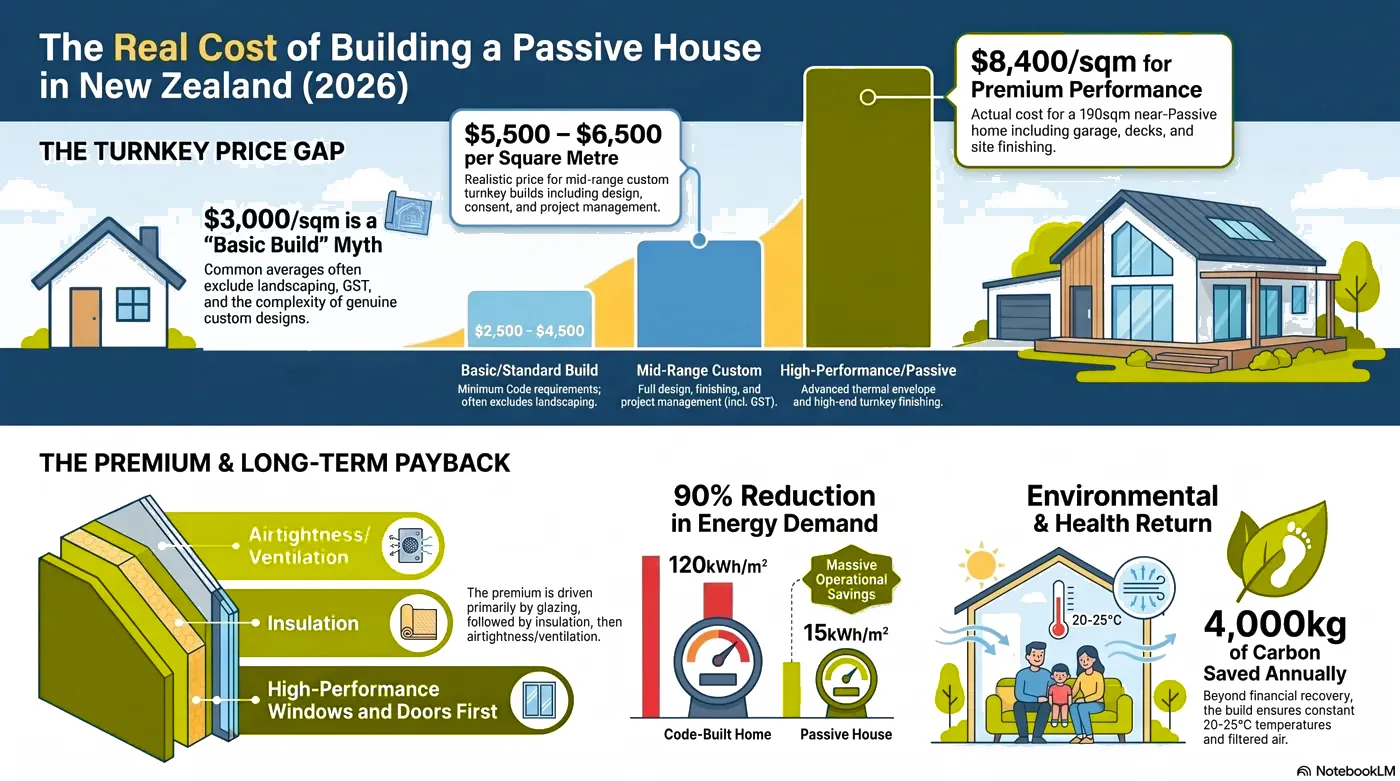
A genuine custom Passive House in New Zealand costs more than the public per-square-metre averages suggest, because those averages come from group and spec homes and leave out design, consent, project management, full turnkey finishing and often GST. As a real example, a recent Ecotectural pricing for a near-Passive 190 square metre home, with a pergola deck, paths and a 40 square metre garage, came to about 1.6 million dollars, roughly 8,400 dollars per square metre all up. For a mid-range custom turnkey build the honest figure is around 5,500 to 6,500 dollars per square metre including GST, and a high-performance or Passive House build sits higher again. The premium over a code build is mostly high-performance windows and doors, then insulation and airtightness, then ventilation, and it is typically recovered over time through far lower running costs.
Key Questions Answered
How much does a Passive House cost per square metre in NZ?
For a custom turnkey build, around 5,500 to 6,500 dollars per square metre including GST for mid-range, and higher for a Passive House. A recent Ecotectural near-Passive pricing worked out to about 8,400 dollars per square metre all up.
Why is that higher than the figures I see online?
Because the common 3,000 to 3,500 dollar per square metre figures are group and spec home averages that leave out design, consent, project management, full turnkey finishing and sometimes GST. A genuine custom turnkey costs more.
Where does the Passive House premium go?
Mostly into high-performance windows and doors, around 40 to 50 percent of the premium, then insulation and airtightness, 25 to 30 percent, ventilation, 15 to 20 percent, and design and modelling (Smart Living Spaces).
Does the extra cost pay off?
Over a long-term home, yes. The premium is typically recovered in under ten years through far lower running costs, with further health and comfort gains (Respond Architects).
In This Guide
Key Takeaways
- A real Ecotectural near-Passive pricing was about 1.6 million dollars for a 190 square metre home plus garage, deck and paths, roughly 8,400 dollars per square metre all up.
- A mid-range custom turnkey build is around 5,500 to 6,500 dollars per square metre including GST; high-performance and Passive House sit higher.
- The common 3,000 to 3,500 dollar per square metre figures are group and spec home averages that exclude design, consent, project management, full finishing and often GST.
- The Passive House premium over code is mostly high-performance glazing, then insulation and airtightness, then ventilation (Smart Living Spaces).
- The premium is typically recovered in under ten years through much lower running costs (Respond Architects).
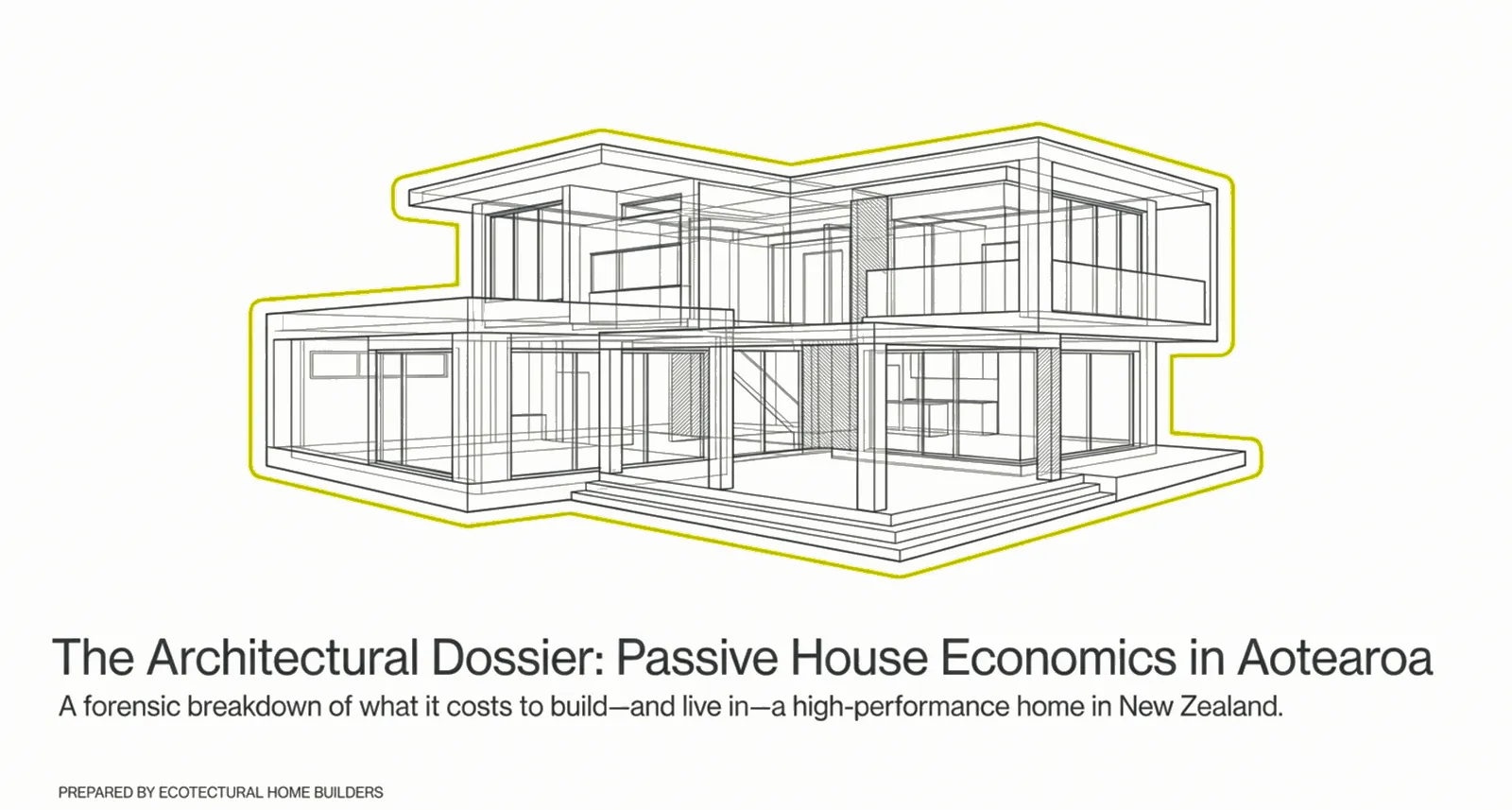
How much does a Passive House cost to build in New Zealand?
More than the figures you will find online, and for an honest reason. The common per-square-metre numbers come from group and spec homes and quietly leave out design, consent, project management, full turnkey finishing and often GST. A genuine custom Passive House, built once and built well, costs more than that average.
To make it real: a recent Ecotectural pricing for a near-Passive 190 square metre home, with a pergola deck, paths and a 40 square metre garage, came to about 1.6 million dollars. That is roughly 8,400 dollars per square metre all up. For a mid-range custom turnkey build the honest figure is around 5,500 to 6,500 dollars per square metre including GST, and a Passive House or high-performance build sits higher again. These are real Nelson Tasman numbers, not a national spec-home average.
Why are the public per-square-metre figures so low?
Because they are measuring something different. National averages of around 3,000 to 3,500 dollars per square metre are drawn largely from group and spec homes built off repeat plans, and they typically exclude design fees, consent, project management, the full turnkey finishing, and sometimes GST. They are an average of the cheapest way to build, not the cost of a one-off custom home.
High-end architectural builds in New Zealand are more often quoted at 3,800 to 4,500 dollars per square metre, with luxury work exceeding 5,000 to 7,000 (Trade Me Property), and that is before you add the Passive House premium and full turnkey finishing. When you compare like for like, a real custom Passive House turnkey figure of 5,500 dollars per square metre and up is exactly what you would expect. The low online numbers are not wrong, they are just answering a different question.
How do you keep the cost under control?
The premium is not fixed, and the biggest lever is engaging your builder early, before the design is locked in. When the builder, architect and energy consultant work as one team from the start, the home can hit the standard efficiently rather than being redesigned late when the modelling does not stack up.
A simple, well oriented form costs less to build to standard than a complex one, the right glazing specified per elevation controls the largest part of the premium, and open-book pricing lets you see exactly where the money goes so you can steer it. Ecotectural builds on open-book transparent pricing, with timesheets and supplier-copy invoices, so there are no hidden margins and no surprises. It is the heart of the design and build approach.
What is the bottom line?
A genuine custom Passive House in New Zealand costs more than the public per-square-metre averages suggest, because those averages exclude design, consent, project management, full finishing and often GST. Real Nelson Tasman figures put a mid-range custom turnkey at around 5,500 to 6,500 dollars per square metre including GST, with a near-Passive home higher again, as in the recent Ecotectural pricing of about 1.6 million dollars for a 190 square metre home with garage, deck and paths.
The premium over a code home is mostly in the glazing, then insulation and airtightness, then ventilation, and it is typically recovered in under ten years through far lower running costs (Respond Architects). The way to make the numbers work is to engage a builder early and price the home openly. If you are planning a high-performance home in Nelson Tasman, the best first step is to arrange a consultation before the design is locked in.
Frequently Asked Questions
Why are real Passive House costs higher than the online calculators say?
Most online figures are per-square-metre averages drawn from group and spec homes, and they quietly exclude design, consent, project management, full turnkey finishing and sometimes GST. A genuine one-off custom home, built to a high standard, costs more than that average, which is why the calculators mislead.
What does a turnkey price include?
Turnkey means everything needed to move in: design, consent, the full build, and all the finishing such as flooring, joinery, tiling and fittings, with project management. It usually excludes land, landscaping and the driveway, which are costed separately.
How big is the Passive House premium over a code home?
It varies by design, but the premium sits mostly in a few line items: high-performance windows and doors first, then insulation and airtightness, then mechanical ventilation, then energy modelling (Smart Living Spaces). Knowing where it goes is what lets a builder manage it.
Can I save money by building to the standard without certifying?
Yes. The performance comes from building to the standard, not from the certificate, so a home can be built to Passive House principles without paying for formal certification. Whether to certify is a separate decision (see our explainer on what a certified Passive House is).
How can I bring the cost down?
Engage your builder early so the design is costed as it develops, keep the form simple and well oriented, specify the right glazing for each elevation rather than the most expensive everywhere, and use open-book pricing so you can see and steer where the money goes.
How does Ecotectural price a build?
Ecotectural builds on open-book transparent pricing: fortnightly labour invoices with timesheets, and monthly materials and subtrade invoices with supplier copies. You see the real cost of your build, with no hidden margin.
Research Report: The Real Cost of a Passive House in New Zealand
Read Full ReportHonest custom turnkey figures, where the premium sits, and how it is recovered, grounded in real Nelson Tasman pricing.
How Ecotectural Can Help
Services and systems related to this guide

Planning a build in Nelson Tasman?
Talk to Ecotectural early and keep control of your design and budget from day one.
Arrange a consultation