

How Much Does a Luxury Architectural Home Cost in NZ?
A luxury architectural home in New Zealand costs well above the square-metre rates quoted for group and volume houses, because you are paying for one-off design, high performance, fine materials and craft, and complete project management, not a repeated plan. Genuine custom, high-performance homes sit in the range of roughly $5,000 to $7,500 per square metre and upward, rising with complexity, site and specification (see our 2026 cost guide). A useful and counter-intuitive rule holds at the top end: larger homes usually cost less per square metre than smaller ones, because a home twice the size does not need twice the kitchens, bathrooms or services. There is no fixed ceiling on luxury, but there is a clear honest floor, and the biggest single variable is nearly always the site.
Key Questions Answered
How much does a luxury architectural home cost in NZ?
Genuine custom, high-performance homes generally run from about $5,000 to $7,500 per square metre and upward, rising with site, complexity and specification. Luxury has no fixed ceiling, but it has an honest floor well above volume-build rates. Our 2026 cost guide breaks the numbers down.
What are you actually paying for at the high end?
One-off design shaped to your site, high performance built to last, fine materials and craftsmanship, more complex construction, and complete project management by one coordinated team. It is a different product from a repeated plan, not just a dearer version of one.
Why do bigger homes cost less per square metre?
Scale of economy. A home twice the size still has one kitchen, one laundry and a single set of services, so the fixed, expensive functions spread across more floor area. That is why a large home can price lower per square metre than a small one.
What pushes a luxury build cost up the most?
The site first of all, since difficult ground, slope and exposure land in the foundations, then specification: extensive glazing, complex forms, premium finishes and high-performance systems. A high-performance build carries roughly a 20 percent premium over code minimum.
Is a luxury architectural home worth the cost?
For buyers who value how a home performs and lasts, yes. A well-designed, high-performance home is warmer, drier, quieter and cheaper to run, and holds its value over decades. It is a fifty-year decision, not a square-metre transaction.
In This Guide
Key Takeaways
- Genuine custom, high-performance homes generally run from about $5,000 to $7,500 per square metre and upward, well above volume-build rates (see the Ecotectural 2026 cost guide).
- At the high end you pay for one-off design, high performance, fine materials and craft, and complete project management, a different product from a repeated plan.
- Scale of economy means larger homes usually cost less per square metre, because kitchens, bathrooms and services do not multiply with floor area.
- The site is the biggest single variable; difficult ground, slope and exposure land in the foundations, the most expensive place for cost.
- A high-performance build carries roughly a 20 percent premium over code minimum, and returns it in comfort, running cost and durability over the home’s life (PHINZ).
How much does a luxury architectural home cost?
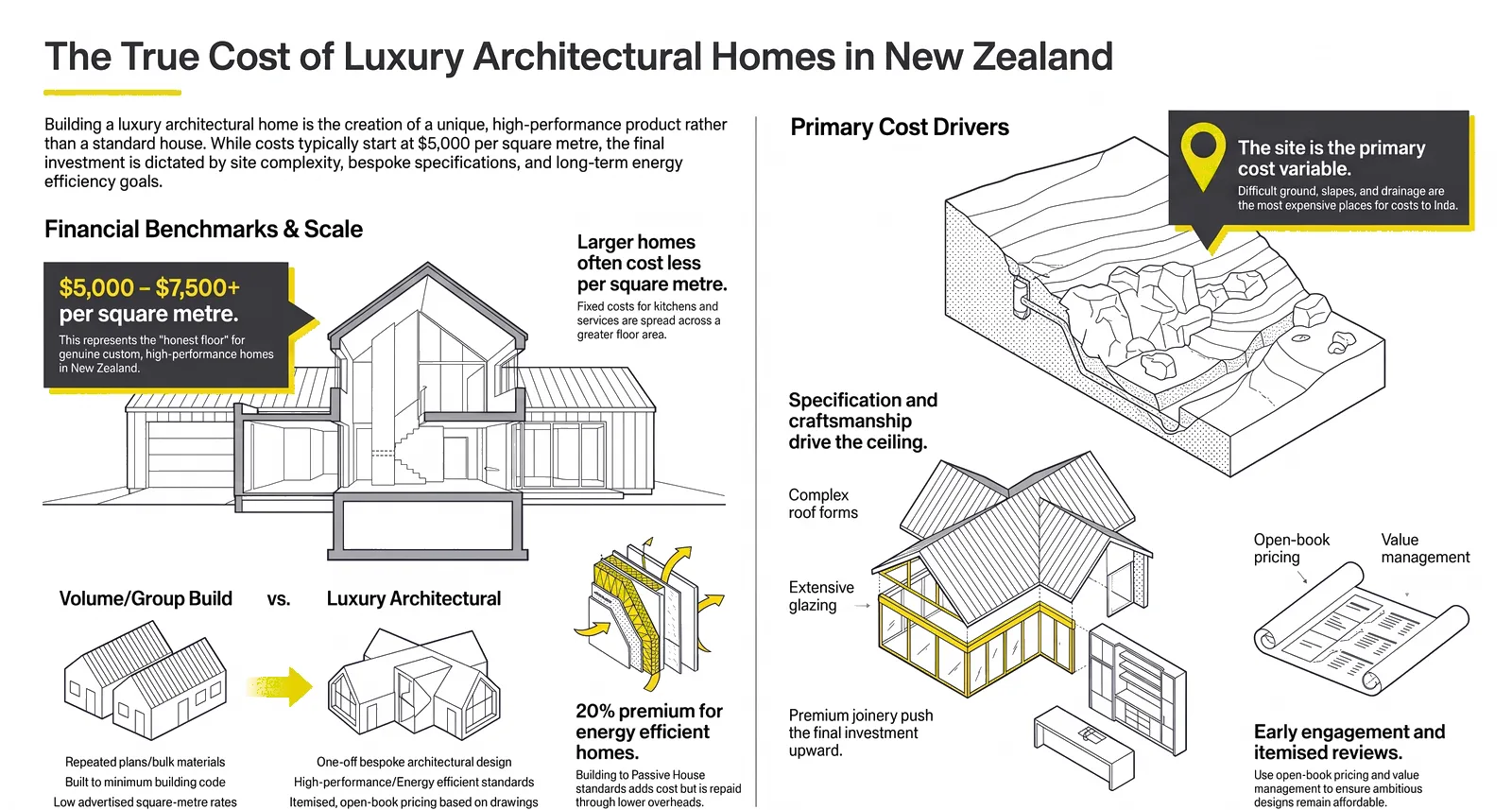
Well above what group and volume builders quote, because it is a different product entirely. As a realistic guide, genuine custom, high-performance homes generally run from about $5,000 to $7,500 per square metre and upward, climbing with site, complexity and specification. The days of building anything genuinely upmarket at the low square-metre rates you see advertised are gone. Luxury has no fixed ceiling, a home can always be larger, more complex or more finely finished, but it has a clear, honest floor, and any number below it has quietly left something out.
Those ranges are a starting point, not a quote, because a one-off home is priced from its own drawings and its own site, not from an average. For the full breakdown of where the money goes across a Nelson Tasman build, our 2026 cost guide is the detailed companion to this article, and our passive house cost guide covers the performance end specifically.
What are you actually paying for at the high end?
Not a dearer version of a standard house, but a different thing altogether. A luxury architectural home buys one-off design shaped to your site and the way you live; high performance built to keep the home warm, dry and quiet for fifty years and more; fine materials and the craftsmanship to install them properly; more complex construction than a simple rectangle on a flat pad; and complete project management by one coordinated team. Each of those is a real cost, and together they are the difference between a house that is merely expensive and a home that is genuinely worth it.
This is why comparing a custom price to a group-builder rate is comparing two different products. A group builder repeats a plan, buys in bulk and builds to the minimum of everything; that is a legitimate, efficient way to deliver a standard house cheaply. A custom builder designs and delivers one home, once, to a far higher standard. You are not paying more for the same thing; you are paying for something the group model cannot produce.
Why do bigger homes cost less per square metre?
This one surprises almost everyone: at the top end, larger homes usually cost less per square metre than smaller ones. It is scale of economy. A home twice the size still has one kitchen, one laundry and a single set of services and connections, so the fixed, expensive functions spread across more floor area, and the rate per square metre falls. A large, well-designed home can therefore price lower per square metre than a compact one, even though its total is higher.
The practical lesson is to be careful with per-square-metre thinking. A small high-end home is not automatically cheap, and a large one is not automatically extravagant on a rate basis. What matters is the whole number and what it delivers, not a headline rate read in isolation. It is one more reason a real, measured price beats any square-metre shortcut, as we explain in how a builder prices your plans.
What pushes a high-end number up the most?
The site comes first, every time. Difficult ground, slope, drainage and exposure all land in the foundations and site works, the least visible and most expensive place for cost to hide, and a spectacular site often carries the most demanding ground. After the site, specification does the rest of the climbing: extensive glazing, complex roof and wall forms, premium finishes and joinery, and high-performance systems. Building to a high-performance or Passive House standard adds roughly 20 percent over code minimum, more than the 10 percent often quoted online (PHINZ), and returns it over the life of the home.
None of these are waste; they are choices, each with a cost and a payoff. The value of engaging a builder early on a high-end home is that every one of these decisions gets made against a real number, with value management finding the same result for less wherever it can. That is how an ambitious home stays an affordable one, and how you avoid the overruns we cover in why build costs blow out.
Is a luxury architectural home worth the cost?
For buyers who care how a home performs and lasts, yes, and the case gets stronger the longer you own it. A well-designed, high-performance home is warmer in winter, cooler in summer, drier, quieter and markedly cheaper to run, and those qualities do not fade; they are built into the fabric for decades (PHINZ). It is a fifty-year decision, and judging it on the square-metre rate alone is like judging a car purely on the sticker and ignoring what it is like to drive and own.
There is a resale dimension too. A genuinely well-built one-off home holds and grows its value in a way a minimum-standard house does not, because quality and performance become rarer and more valued over time, not less. Whether the premium is worth it is ultimately personal, but for the right buyer it is not really a cost at all, it is the whole point. Our guide to whether a passive house is worth it weighs it up in full.
What is the bottom line?
A luxury architectural home in New Zealand costs well above volume-build rates, generally from around $5,000 to $7,500 per square metre and upward, because you are buying one-off design, high performance, craft and complete project management, not a repeated plan. Remember the counter-intuitive rules: larger homes often cost less per square metre, the site is the biggest cost variable, and high performance adds about 20 percent that it repays over the life of the home. Luxury has no ceiling, but it does have an honest floor.
The way to build ambitiously without losing control is process, not budget: engage early, price open book, hold your contingency, and choose value management over cost-cutting. If you are planning a high-end home in Nelson Tasman, book a plan pricing review and you will get a real, itemised number for your design, with a builder’s eye on where to spend and where to save.
Frequently Asked Questions
Is there a fixed price for a luxury home?
No. Luxury has no ceiling, because specification, site and scale can all keep climbing. What it does have is an honest floor: a genuine custom, high-performance home cannot be built at volume-house rates, and any number that suggests otherwise has left something out. Our cost guide sets out realistic ranges.
Why is a custom home so much more than a group-built house?
Because it is a different product. A group builder repeats a plan, buys in bulk and builds to a minimum standard; a custom builder designs one home for one site, builds it to perform for decades, and manages the whole project. You are not paying more for the same thing, you are paying for a different thing.
Do smaller luxury homes cost less?
Less in total, but often more per square metre. A small home still needs a kitchen, bathrooms and full services, so those fixed costs spread across less floor area. It surprises people, but a compact high-end home can carry a higher per-square-metre rate than a large one.
How much does high performance add?
Building to a high-performance or Passive House standard adds roughly 20 percent over code minimum, more than the 10 percent often quoted online (PHINZ). It buys a home that is warmer, drier, quieter and far cheaper to run, which is why we treat it as value rather than cost. Our passive house cost guide goes deeper.
What is the biggest cost risk on a high-end build?
The site. Difficult ground, slope, drainage and exposure all land in the foundations and site works, the least visible and most expensive place for a surprise. Having a builder assess the site before you buy is the strongest protection at any budget.
How do I keep a luxury build under control?
The same way as any build, only with more at stake: engage a builder early, price open book from complete plans, hold a firm 10 percent contingency, and choose value management over cost-cutting. A big budget is not protection; process is.
Research Report: The Cost of a Luxury Architectural Home in NZ
Read Full ReportWhat high-end pricing reflects, and the counter-intuitive rules of scale and performance.
Planning a build in Nelson Tasman?
Talk to Ecotectural early and keep control of your design and budget from day one.
Arrange a consultation