

Tendering Your Plans vs Partnering With One Builder
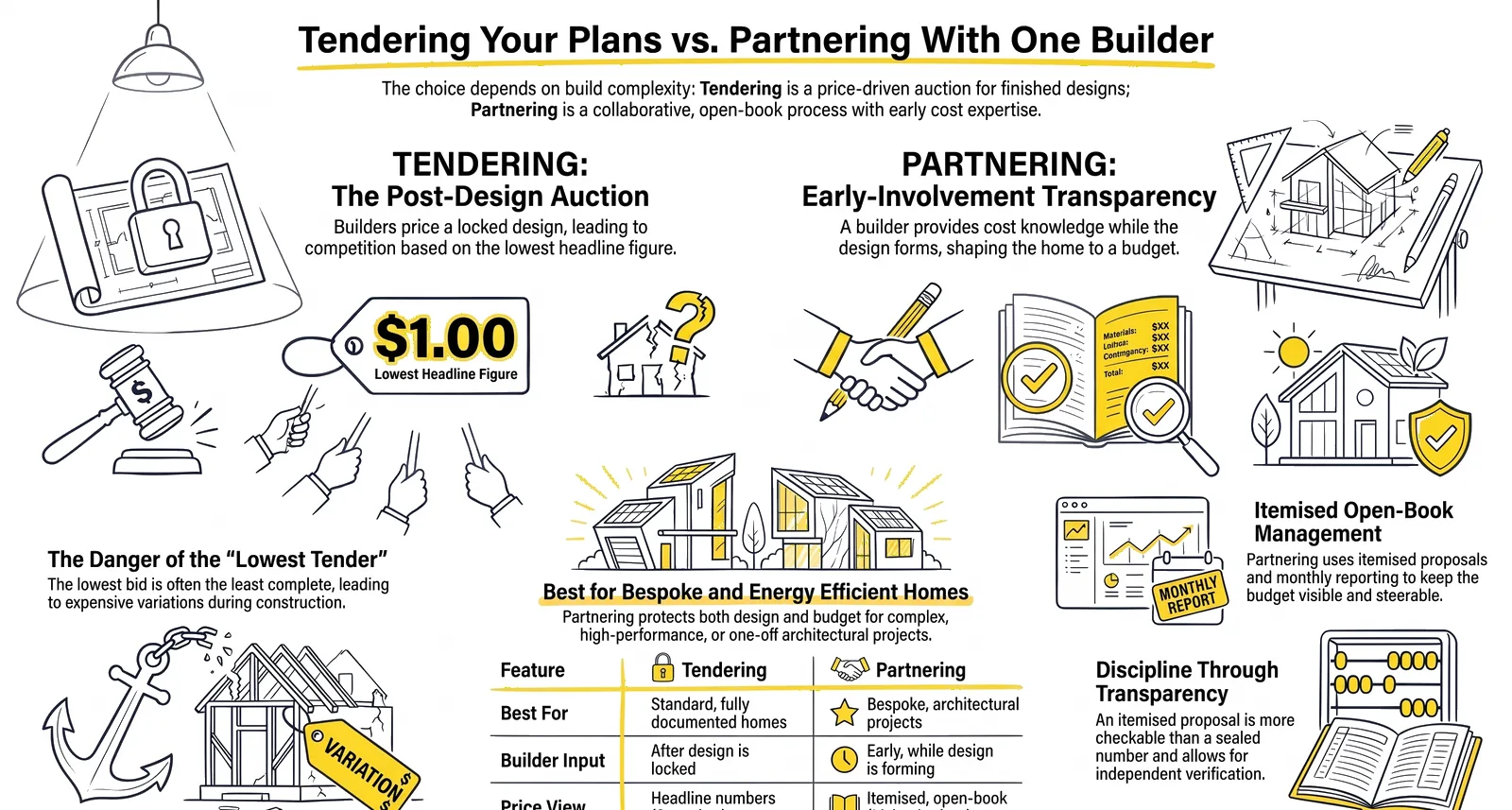
Tendering means finishing your plans, then sending them to several builders to quote competitively and taking the best price. Partnering means engaging one builder early and open book, so the home is designed to a real budget as you go. Tendering can create price tension, but on a one-off home it also invites each builder to guess at whatever the plans leave unclear, and the lowest number usually means the least was included rather than the least it will cost. Partnering trades the auction for transparency: one team, an itemised price you can read, value management, and monthly reporting, so you compare on substance and keep control of both design and budget.
Key Questions Answered
What does tendering your plans mean?
Completing your design, then issuing the plans to several builders who each price them and submit a quote, so you can compare and choose. It works best when the plans are fully documented and leave nothing to interpretation.
What does partnering with one builder mean?
Engaging a single builder early, often before the design is finished, and pricing openly as you go. The home is designed to a real budget, with the builder’s cost knowledge shaping decisions while they are still cheap to make.
Is the lowest tender the cheapest build?
Rarely on a one-off home. A lower tender usually means fewer items were included or leaner allowances were assumed, and the gap returns as variations once you are committed. Compare itemised proposals, not headline numbers.
When does tendering make sense?
When the plans are complete and fully specified, the build is relatively standard, and every builder is genuinely pricing the same thing. Then price tension works in your favour without much room for hidden gaps.
When is partnering the better choice?
On bespoke, architectural or high-performance homes, where details matter, the site is real, and value management and early cost input save far more than an auction ever could.
In This Guide
Key Takeaways
- Tendering issues finished plans to several builders for competitive quotes; partnering engages one builder early and prices openly as the design develops.
- On a one-off home the lowest tender usually reflects the least included, not the least it will cost; omitted items return as variations after commitment.
- Tendering suits fully documented, relatively standard builds where every builder prices exactly the same thing.
- Partnering suits bespoke and high-performance homes, where early cost input and value management save more than price tension does.
- Open-book pricing gives you the cost check tendering promises, an itemised price you can read and track, without the adversarial race to the bottom.
What is tendering, and what is partnering?
Tendering is the traditional route: you finish your plans, issue them to several builders, and each one prices the same drawings and hands back a quote. You compare, you choose, usually on price. Partnering is the other path: you engage one builder early, often before the design is finished, and price openly as you go, so the home is designed to a real budget from the start rather than measured against one at the end. Both are legitimate; they simply suit very different builds.
The key difference is timing. Tendering puts the builder in after the design is locked, so their only move is to price what is on the page. Partnering puts the builder in while the design is still forming, so their cost knowledge can shape it. On a standard, fully documented home that early input matters less. On a one-off architectural home it matters enormously, which is the whole argument for engaging a builder before an architect.
What does tendering actually get you?
In theory, price tension: several builders competing sharpens the number. That works cleanly when the plans are complete and fully specified, because everyone is pricing the identical thing. The trouble on a one-off home is that no set of plans specifies everything, so each builder has to guess at the gaps, and the builder who guesses most optimistically, or leaves the most out, wins the tender. You have not necessarily found the cheapest build; you have found the most optimistic quote.
That is the quiet risk in picking the lowest tender: it is often the least complete one. The items it assumed away still have to be built, and they come back as variations once you are committed and switching builders would cost more than paying up. The auction that felt like it was protecting your budget was quietly setting it up to move. Our guide to how a builder prices your plans shows where those gaps hide.
What does partnering with one builder get you?
Partnering trades the auction for transparency. You choose one builder on evidence, their homes, their clients, their pricing and their guarantees, and then you get their cost knowledge working for you from early in the design. The home is shaped to a budget as it is drawn, value management runs throughout, and the price is open book: an itemised proposal you can read, with monthly reporting against it as the build proceeds. You compare builders on substance up front, then keep control of design and budget all the way through.
Done this way you actually get more price discipline than a tender, not less. A single tendered figure is a snapshot you either accept or reject; an open-book partnership is a living budget you can see and steer, decision by decision. When something moves, you know early, while there are still options. That is control, and it is the opposite of discovering your real cost at the end.
Which one suits your build?
The honest answer depends on what you are building. Here is how the two approaches line up.
| Tendering | Partnering | |
|---|---|---|
| Best for | Fully documented, standard homes | Bespoke, architectural, high-performance homes |
| Builder involved | After the design is locked | Early, while the design is forming |
| Price you compare | Headline numbers, often on different assumptions | One itemised, open-book proposal you can read |
| Value management | Little room, design is fixed | Throughout, before decisions are locked |
| Main risk | Lowest tender is least complete | Choosing the wrong single builder |
| Budget control | A number at the start | Monthly reporting the whole way |
If your build is genuinely standard and your plans are complete to the last detail, a tender can serve you well. If it is a one-off home where the details, the site and the performance all matter, partnering almost always protects both the design and the budget better.
How do you get competitive pricing without a race to the bottom?
This is the part people miss: the thing tendering promises, a sharp, checkable price, is exactly what open-book partnering delivers, without the adversarial race. An itemised proposal you can read line by line is more checkable than three sealed numbers, because you can see the scope, the allowances and the margin, and you can bring in an independent quantity surveyor to sanity-check it if you want. You get the discipline of competition without inviting everyone to win by leaving things out.
And there is a cost to tendering that nobody advertises. A genuine quote takes many hours to prepare (MyHome Renovations), and builders pricing tenders they mostly lose have to recover those hours in the work they win. Free competitive tendering spreads its real cost across every client’s price. Paying one builder to price your plans properly, and having that fee come back off your build, puts the cost where the decision is.
What is the bottom line?
Tendering suits fully documented, standard builds where every builder prices the identical thing and price tension does its job. On a one-off architectural home it tends to reward the most optimistic quote, and the lowest tender is usually the least complete, not the cheapest to build. Partnering with one builder, chosen on evidence and pricing open book, gives you early cost input, value management and a budget you can watch develop, which protects both the design and the money.
If you hold plans for a one-off home in Nelson Tasman, you do not have to run an auction to get an honest, checkable price. Book a plan pricing review and you will get an itemised number you can compare on substance, with the fee refunded off your build when you proceed.
Frequently Asked Questions
Is tendering not the way to get the best price?
It can be, on a fully specified, standard build where every builder prices the identical thing. On a one-off home, tenders diverge mostly on what each builder assumed or left out, so the exercise often compares interpretations rather than prices, and rewards the most optimistic guess.
What is the risk of picking the lowest tender?
That you have chosen the least complete quote, not the cheapest build. The items it missed still have to be built, and they arrive as variations at a point where changing builders would cost more than paying up. The gap closes on site, at the worst time to pay for it.
Can I still compare builders if I partner with one?
Yes, and you should do your homework before you choose: their homes, their clients, their pricing, their guarantees. What you gain by partnering is a builder’s cost knowledge shaping the design early, which no tender can give you because tendering happens after the design is locked.
Does partnering mean I lose price discipline?
No, the opposite, if the builder prices open book. You see every line, get monthly reporting, and can apply value management throughout. That is more price discipline than a single tendered number, not less, because you can see and steer the cost the whole way.
What if I have already finished my plans?
Then you can tender them, or you can bring them to one builder for a proper pricing pass and build from there. Finished plans do not force a tender; a single itemised pricing review often tells you more than three headline numbers.
Does tendering cost the builders anything?
Yes, a great deal. A genuine quote takes many hours to prepare (MyHome Renovations), and builders pricing tenders they mostly lose recover those hours in the jobs they win. Free competitive tendering is not really free; its cost is spread across everyone’s prices.
Research Report: Tendering vs Partnering With One Builder
Read Full ReportWhen competitive tendering serves you, and when early open-book partnering protects the build.
Planning a build in Nelson Tasman?
Talk to Ecotectural early and keep control of your design and budget from day one.
Arrange a consultation