

Why Build Costs Blow Out, and How to Prevent It
Most build cost blowouts trace back to a few predictable causes: a quote pitched below true cost to win the work, plans that were priced before they were complete, the surprises hidden in the ground, and no contingency to absorb any of it. The blowout is rarely one big shock; it is a run of variations, each legitimate under a contract that was never really complete. You prevent it the same way every time: engage a builder early, price open book from complete plans, hold a firm 10 percent contingency, and choose a builder who costs honestly and tracks the budget every month rather than one who simply quotes the lowest number.
Key Questions Answered
Why do build costs blow out?
Usually a combination: a lowball quote that was never the real cost, plans priced before they were finished, unknowns in the ground, and no contingency. The overrun arrives as a stream of variations rather than a single shock.
What is the biggest hidden cost in a build?
Site works and foundations. You cannot fully see the ground until you dig, so unstable soil, slope, drainage and access are where budgets most often move. A builder assessing the site early is the best defence.
How does a lowball quote cause a blowout?
A builder quotes below true cost to win the job, then recovers it through variations once you are committed. The number that looked cheapest becomes the build that ran over, because the real cost was always going to arrive.
What costs sit outside the building contract?
Commonly driveways and landscaping, service connections, window furnishings, and the interest you pay during the build. They are real costs that catch people who budgeted only for the contract figure.
How do you prevent a blowout?
Engage a builder early, price open book from complete plans, keep a firm 10 percent contingency, and choose a builder who costs honestly and holds a monthly budget meeting, so problems surface while they are still small.
In This Guide
Key Takeaways
- Cost blowouts usually come from lowball quotes, plans priced before completion, unknowns in the ground, and missing contingency, arriving as a stream of variations.
- Site works and foundations are the biggest hidden cost, because ground conditions cannot be fully seen until excavation begins.
- A fixed price is only as fixed as the drawings behind it; anything the plans miss can legally return as an extra.
- Real costs often sit outside the building contract: driveways, landscaping, service connections, furnishings and interest during the build.
- Prevent overruns by engaging a builder early, pricing open book from complete plans, holding a 10 percent contingency, and choosing a builder who costs honestly and reports monthly.
Why do build costs blow out?
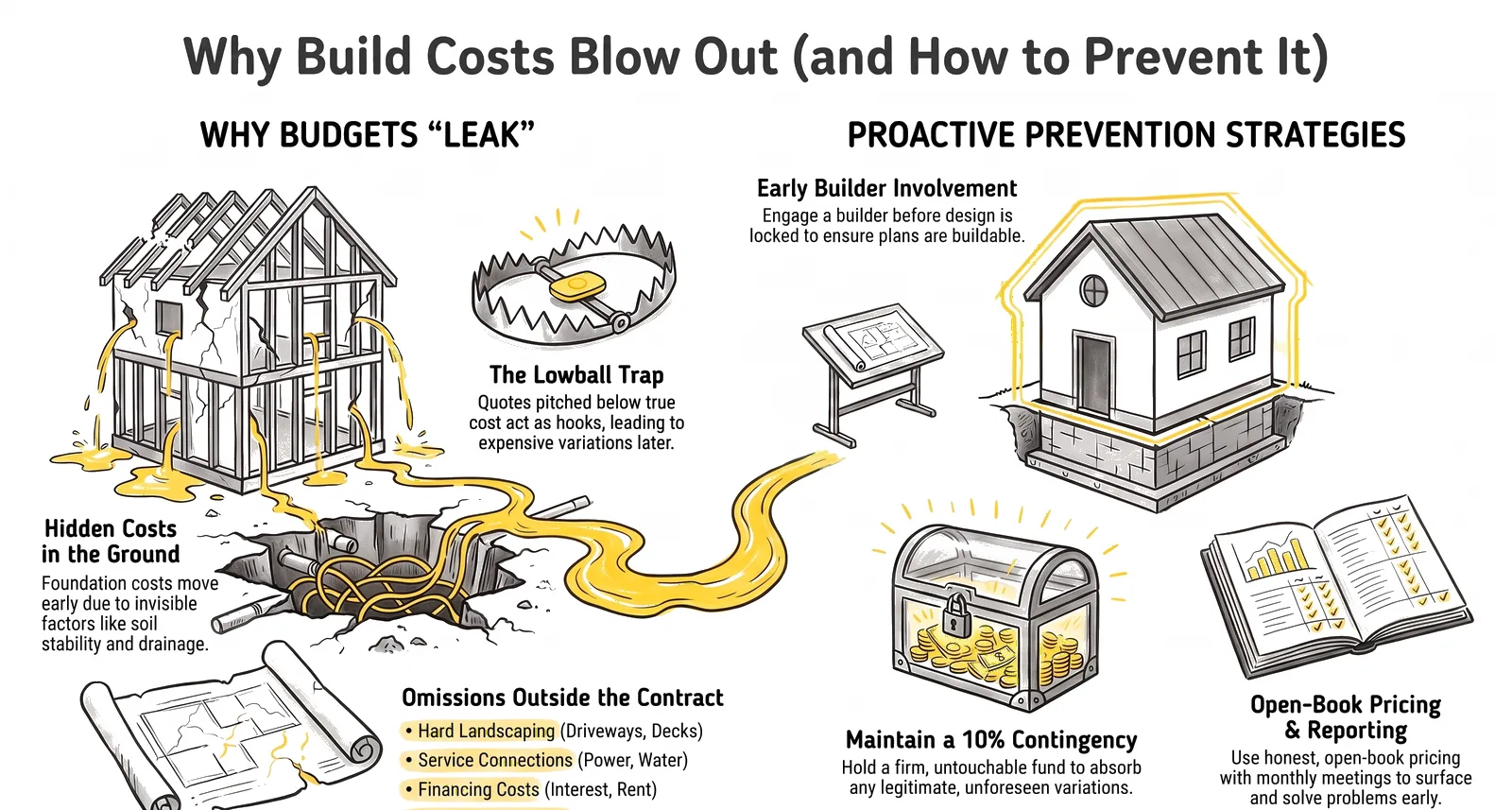
Cost blowouts are rarely one dramatic event. They are a slow accumulation of variations, each one legitimate under a contract that was never really complete. Trace them back and you find the same handful of causes: a quote pitched below the true cost to win the work, plans that were priced before they were finished, unknowns waiting in the ground, and no contingency to absorb any of it. Put those together and a budget does not so much break as leak, steadily, from the moment work starts.
The reason building is so often called one of the most stressful things people do is almost entirely this pattern. It is also almost entirely preventable, because the causes are known and predictable. The rest of this guide walks through the big ones and the moves that shut each of them down.
How does the lowball trap work?
Here is a hard truth from years of paying every invoice on real builds: plenty of quotes come in below the true cost, deliberately, to win the work or to get a build approved by a bank. The low number is not a saving, it is a hook. Once you are committed and the work is under way, the real costs arrive as variations, and by then changing builders would cost more than paying up. The cheapest quote and the build that blew out are very often the same project.
The fix is counter-intuitive: choose a builder who costs on the honest, higher side, so the quoted price is close to what you actually pay rather than a hopeful figure that grows. Look for one who prices openly, tracks the budget every week, and has the management capacity to chase the best pricing and direct the subtrades properly. Then trust them and listen to them. A number you can rely on is worth far more than a low number you cannot. Our guide to open-book versus fixed-price contracts explains why the lowest figure so rarely holds.
What costs live outside the building contract?
Some of the most common budget shocks are not overruns at all, they are real costs that simply sat outside the building contract and never made it into the plan. People budget carefully for the house, then get caught by everything around it. Knowing the usual suspects in advance takes the sting out of them.
| Often outside the contract | Why it catches people |
|---|---|
| Driveways and hard landscaping | Priced separately, easy to forget until the end |
| Service connections | Power, water and wastewater to the site can be significant |
| Window furnishings and blinds | Assumed included, often are not |
| Interest during the build | You pay to borrow while you also pay rent or a mortgage |
| Fencing, decks, planting | The finishing touches that complete the property |
A good builder will tell you plainly which of these are in the contract and which are not, so you can budget for the whole property rather than just the house. Where finishing items would break the budget now, some can be staged for later, which is a far better outcome than a nasty surprise at handover. Our financing guide covers the interest cost during construction.
How do you actually prevent a blowout?
Every prevention move points the same way: know the real cost early, and keep it visible. Engage a builder before the design is locked, so the plans are drawn to a real price and checked for buildability, because architects and designers can leave things off a drawing that only a builder catches. Price open book from complete plans, so nothing is a guess. Hold a firm 10 percent contingency and treat it as untouchable. And choose a builder who runs a monthly budget meeting, so if anything on the horizon threatens the number, you hear it immediately, with a plan, while the problem is still small.
That last part is the quiet difference between a build that stays calm and one that spirals. Money is the biggest stress point in any project, so the faster everyone knows about a pressure, the more options everyone has to deal with it. A builder who surfaces problems early is not admitting weakness, they are protecting your budget the only way it can actually be protected.
What is the bottom line?
Build costs blow out for reasons that are almost boringly predictable: lowball quotes, incomplete plans, surprises in the ground, forgotten costs outside the contract, and no contingency to catch any of it. None of them are bad luck, and all of them are preventable. Engage a builder early, price open book from complete plans, budget for the whole property, keep a firm 10 percent contingency, and pick a builder who costs honestly and reports monthly rather than one who simply quotes the lowest number.
Do those things and a build stops being a gamble. If you want a number you can actually rely on for a home in Nelson Tasman, arrange a consultation and we will show you how open-book pricing and monthly reporting keep the cost side calm from start to finish.
Frequently Asked Questions
Is a fixed-price contract the safest way to avoid a blowout?
Not on its own. A fixed price is only as complete as the drawings it was based on, so if the plans miss detail, the extras come back as legitimate variations on top of the fixed number. A transparent, itemised price from complete plans tells you far more than a single locked figure.
Why is the ground such a big risk?
Because you cannot fully see it until you break it. Slope, unstable soil, drainage and access all land in the foundations and site works, the most expensive place for a surprise. Most of the time, when a budget moves early, it is in the foundations.
How do I spot a lowball quote?
It is usually the lowest, the least itemised, and the quickest to arrive. The tell is that you cannot see the workings. A price you can read line by line, from a builder who costs on the honest side, is worth more than a cheap number with its risk hidden.
What is the point of a contingency if I have a fixed price?
To absorb what no plan captures. Even a well-drawn one-off home turns up the unexpected, and a 10 percent contingency is what keeps that from becoming a crisis. If you cannot fit the contingency, the budget is not ready to build yet.
How does open-book pricing prevent overruns?
By making cost visible and early. You see every line and get monthly reporting against it, so when something moves you know while there are still options, rather than discovering it at the end. Surprises shrink when nothing is hidden.
Why choose a builder who costs on the high side?
Because the quoted price is then close to what you actually pay, not a hopeful number that grows on site. A builder who prices honestly, tracks the budget weekly and has the management capacity to chase good pricing gives you a number you can rely on. Trust the builder and listen to them.
Research Report: Why Build Costs Blow Out
Read Full ReportThe predictable causes of cost overruns and the controls that prevent them.
Planning a build in Nelson Tasman?
Talk to Ecotectural early and keep control of your design and budget from day one.
Arrange a consultation