

Is Your Home Making You Sick? An Indoor-Air and Health Self-Check
If your home has condensation on the windows, visible mould, a musty smell, rooms you cannot keep warm, or air that feels stuffy, it may be affecting your health. Cold, damp, mouldy homes are linked to respiratory illness and poorer health, and they are common in New Zealand: BRANZ HEEP2 research found about half of NZ homes had visible mould and about a third were damp at least some of the time (Sustainable Engineering). The encouraging part is that the cause is the building, not bad luck, so it can be designed out. A warm, dry, well-ventilated home, built with continuous insulation, airtightness, high-performance glazing and mechanical ventilation with heat recovery, removes the conditions that make people unwell.
Key Questions Answered
What are the signs my home might be making me sick?
Condensation on windows, visible mould or black spots, a musty smell, cold rooms you cannot keep warm, and stuffy air. Each points to damp, cold or poor ventilation, the conditions linked to poorer health (BRANZ HEEP2).
How do cold, damp homes affect health?
Cold, damp and mouldy homes are linked to respiratory illness, worse asthma and poorer general health. Mould and dust mites thrive in damp air, and cold stress is hardest on children and older people (BRANZ HEEP2).
Is this a common problem in NZ?
Yes. BRANZ HEEP2 found about 50 percent of NZ homes had visible mould and about a third were damp at least some of the time (Sustainable Engineering), and about 28,000 homes are always damp with mould (Stuff).
Can I fix it, or do I need a new home?
You can improve an existing home with insulation, better glazing and ventilation, though results are often partial. A new build, or a knockdown rebuild, lets you design the problem out entirely from the start.
How does a new build keep a home healthy?
With continuous insulation, an airtight envelope, high-performance glazing and mechanical ventilation with heat recovery. Together they keep the home warm and dry and supply constant fresh, filtered air, the same principles as a Passive House.
In This Guide
Key Takeaways
- Condensation, visible mould, a musty smell, cold rooms and stuffy air are the everyday warning signs that a home is damp, cold or poorly ventilated.
- Cold, damp, mouldy homes are linked to respiratory illness and poorer health, with children and older people most affected (BRANZ HEEP2).
- The problem is common: about 50 percent of NZ homes had visible mould and about a third were damp at least some of the time (Sustainable Engineering); about 28,000 are always damp with mould (Stuff).
- Being a new build does not guarantee a healthy home; condensation and mould depend on insulation, airtightness, glazing and ventilation, not age.
- A warm, dry, well-ventilated home, built with continuous insulation, airtightness, high-performance glazing and heat recovery ventilation, removes the conditions that make people unwell.
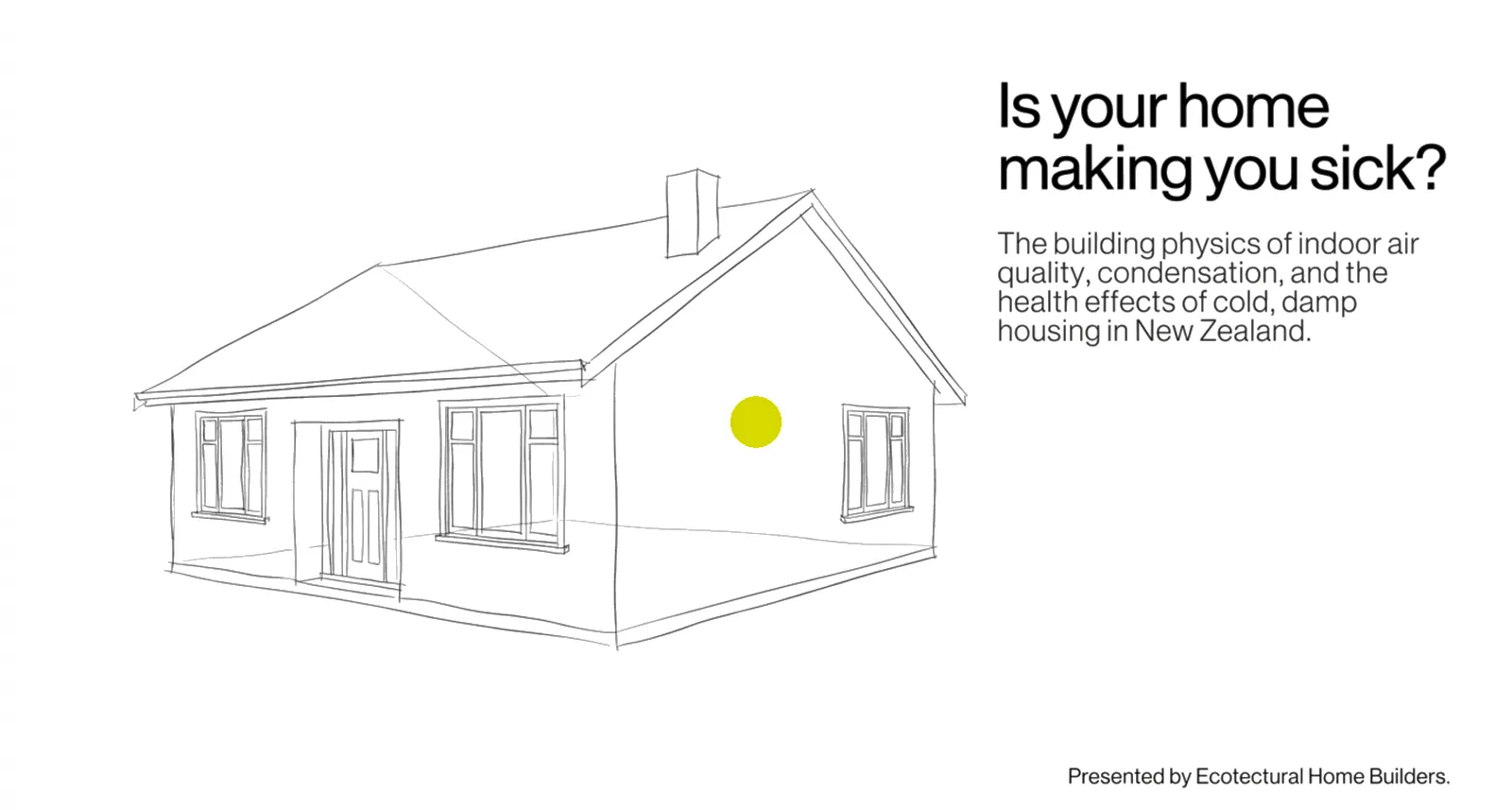
Is your home making you sick?
It might be. A home does not infect you, but a cold, damp, mouldy home creates conditions that are linked to respiratory illness, allergies, worse asthma and poorer general health (BRANZ HEEP2). If your family seems to get more coughs and colds over winter, or someone’s asthma is worse at home, the building could be part of the story.
This is not rare, and it is not your fault. New Zealand has a well documented problem with cold, damp housing, and most of it comes down to how homes are built. The good news is that because the cause is the building, it can be measured, understood and designed out. Start with the simple self-check below.
The self-check: what are the warning signs?
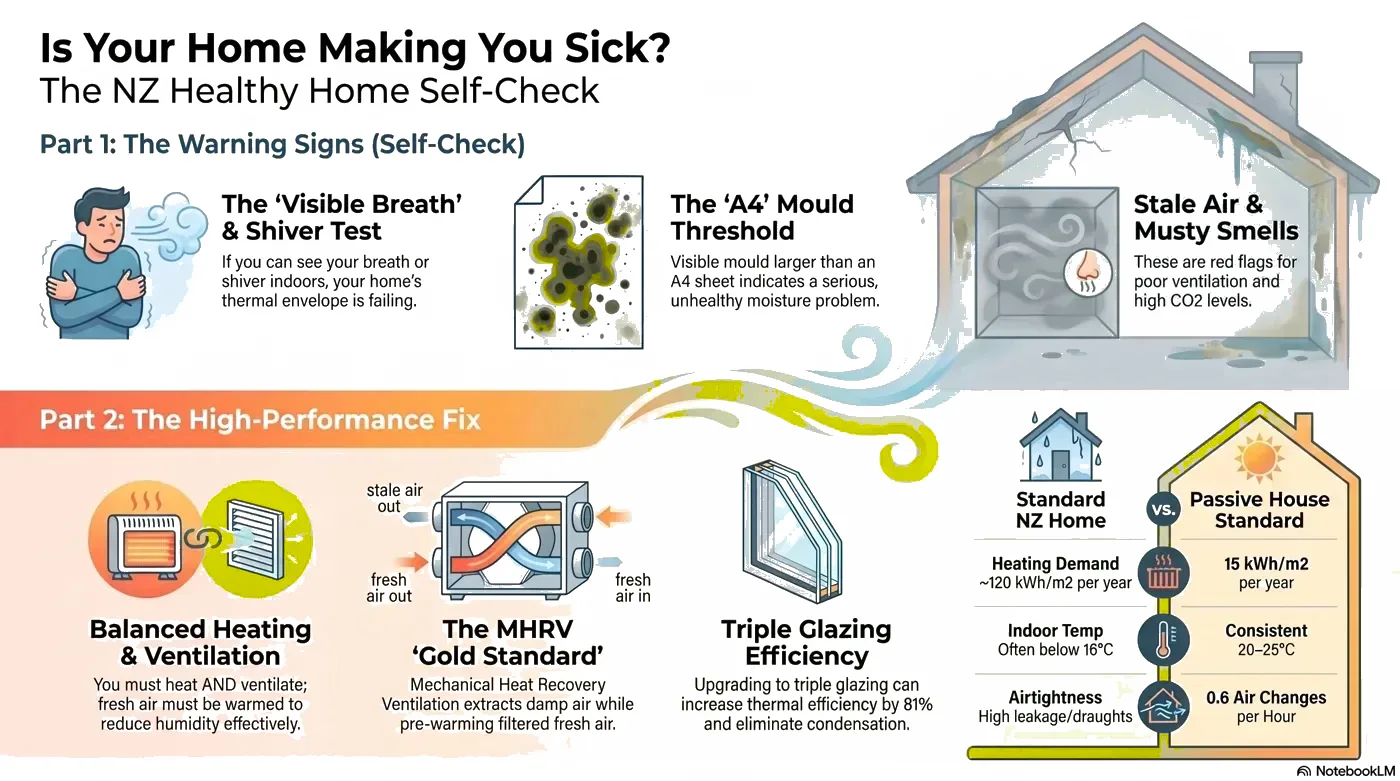
Walk through your home and look for these signs. Each one points to damp, cold or poor ventilation, and each has a clear fix in a healthy home. The more you recognise, the more the building is working against you.
| Warning sign | What it points to | Health risk | The fix in a healthy home |
|---|---|---|---|
| Condensation on windows in the morning | Moist air meeting cold glazing | Mould growth and allergens | High-performance glazing and ventilation |
| Visible mould or black spots | Ongoing damp and poor ventilation | Respiratory illness, asthma triggers | Airtightness and heat recovery ventilation |
| A musty or stuffy smell | Stale, humid air with nowhere to go | Poor indoor air quality | Mechanical ventilation with heat recovery |
| Rooms you cannot keep warm | Too little insulation and air leakage | Cold stress, worst for children and older people | Continuous insulation and airtightness |
| Damp walls, peeling paint or wardrobes that smell | Excess humidity and cold surfaces | Mould and dust mites | Insulation, glazing and ventilation together |
| Seeing your breath indoors in winter | Severe heat loss | Cold-related illness | A whole-envelope upgrade or a new build |
If you ticked two or three, your home is likely cold or damp enough to affect comfort and health. If you ticked most of them, the building is the problem, and patching one symptom at a time rarely fixes it.
What does cold and damp actually do to your health?
Cold, damp and mould are linked to real health effects, not just discomfort. Damp air and mould feed respiratory problems and trigger asthma and allergies, while a cold home adds cold stress that is hardest on babies, children and older people (BRANZ HEEP2).
The New Zealand evidence is sobering. BRANZ HEEP2 research, covering more than 750 households, found about half had visible mould, about one in five people reported seeing their breath indoors and shivering in winter, and about a third said their home was damp at least some of the time (Sustainable Engineering). About 28,000 homes are always damp and always have visible mould (Stuff). The hardest part is how normal this has become: most people still consider their home healthy despite the cold and the mould. It does not have to be that way.
Why is this so common in New Zealand homes?
Because most homes are built to the Building Code minimum, which the SuperHome Movement notes sits well behind comparable countries. A home built to the minimum often has modest insulation, a leaky envelope, low-spec glazing and no controlled ventilation, which is exactly the recipe for cold and damp.
It is also why being a new build does not guarantee a healthy home. A new house built only to the Code can still get condensation and mould from day one. Modern homes are often tighter than old ones without adding ventilation to match, so moisture from everyday living builds up with nowhere to go. The fix is not to leak more, it is to insulate, seal and ventilate on purpose. Our guide to why NZ homes are cold and damp goes deeper on the causes.
Can you fix your current home, or do you need a new one?
It depends how far gone the building is. Some homes can be improved with added insulation, better glazing and mechanical ventilation, and that is worth doing where the bones are sound. The honest catch is that retrofits are often partial: it is hard and costly to reach a genuinely warm, dry result in a home that was never designed for it.
Where a home is fundamentally cold, damp or poorly laid out, a new build or a knockdown rebuild is often the cleaner answer, because you design the problem out from the start rather than chasing it. If you are weighing the options for a long-term, healthy home, that decision is worth costing properly before you commit.
How does a new build design the sickness out?
A healthy home is built, not bolted on. Four building-science measures work together to remove the conditions that make people unwell: continuous insulation, an airtight envelope, high-performance glazing, and mechanical ventilation with heat recovery. These are the core of the Passive House standard.
Insulation and airtightness keep the home warm and stop the draughts. High-performance glazing keeps window surfaces warm so condensation cannot form (Koffman). Heat recovery ventilation continuously removes moist, stale air and supplies fresh, filtered air, which keeps humidity down and filters out pollen and outdoor particulates, a real benefit for anyone with allergies or asthma. Thermal-bridge-free detailing removes the cold junctions where mould starts. The result is a home that is warm, dry, quiet and healthy without a fight. For how these work together, see the five principles of a Passive House, and for whether the investment stacks up, whether a Passive House is worth it. This is the heart of Ecotectural’s design and build approach.
What is the bottom line?
If your home has condensation, mould, a musty smell, cold rooms or stuffy air, it may well be affecting your health, and you are not imagining it. Cold, damp, mouldy homes are linked to respiratory illness and poorer health, and they are common in New Zealand (BRANZ HEEP2, Sustainable Engineering). The cause is the building, which means it can be fixed.
A warm, dry, well-ventilated home, built with continuous insulation, airtightness, high-performance glazing and mechanical ventilation with heat recovery, removes the conditions that make people unwell, and keeps doing so for the life of the home. If you are planning a build in Nelson Tasman and want a home that protects your family’s health rather than undermining it, the best first step is to arrange a consultation before the design is locked in.
Frequently Asked Questions
Can a house really make you sick?
A house does not infect you, but a cold, damp, mouldy home creates conditions linked to respiratory illness, allergies and worse asthma, and cold stress that is hardest on the young and old (BRANZ HEEP2). Fixing the damp, cold and ventilation removes those conditions.
Why does my home get so much condensation?
Condensation forms when moist indoor air, from cooking, showers, drying washing and breathing, meets a cold surface such as single or low-spec glazing. It is a sign the home is too cold at the surface and not ventilated enough. High-performance glazing and mechanical ventilation fix it (Koffman).
Is mould just a cleaning problem?
No. Mould is a symptom of ongoing damp and poor ventilation. You can wipe it away, but unless you fix the moisture and air movement it returns. The real fix is a warm, dry, well-ventilated building, not bleach.
Will opening windows fix a stuffy, damp home?
It helps a little but it is not a reliable fix, and it dumps your heat outside. A warm, dry home uses mechanical ventilation with heat recovery to supply constant fresh air while keeping the warmth in, so you do not have to choose between fresh and warm.
Can an existing home be made healthy?
Often partly. Adding insulation, better glazing and ventilation improves an existing home, but it can be hard and costly to reach a genuinely warm, dry result. Where a home is fundamentally cold and damp, a new build or a knockdown rebuild is often the cleaner answer.
How does Ecotectural build healthy homes?
Ecotectural builds Passive Homes, combining continuous insulation, airtightness, high-performance glazing and heat recovery ventilation so the home stays warm, dry and healthy. The approach is designed in from the first sketch, not added later.
Research Report: Indoor Air, Health and the New Zealand Home
Read Full ReportThe warning signs of an unhealthy home, the health evidence, and the building-science measures that fix it.
How Ecotectural Can Help
Services and systems related to this guide

Planning a build in Nelson Tasman?
Talk to Ecotectural early and keep control of your design and budget from day one.
Arrange a consultation