

Financing a New Build in NZ: Construction Loans and Progress Payments, Explained
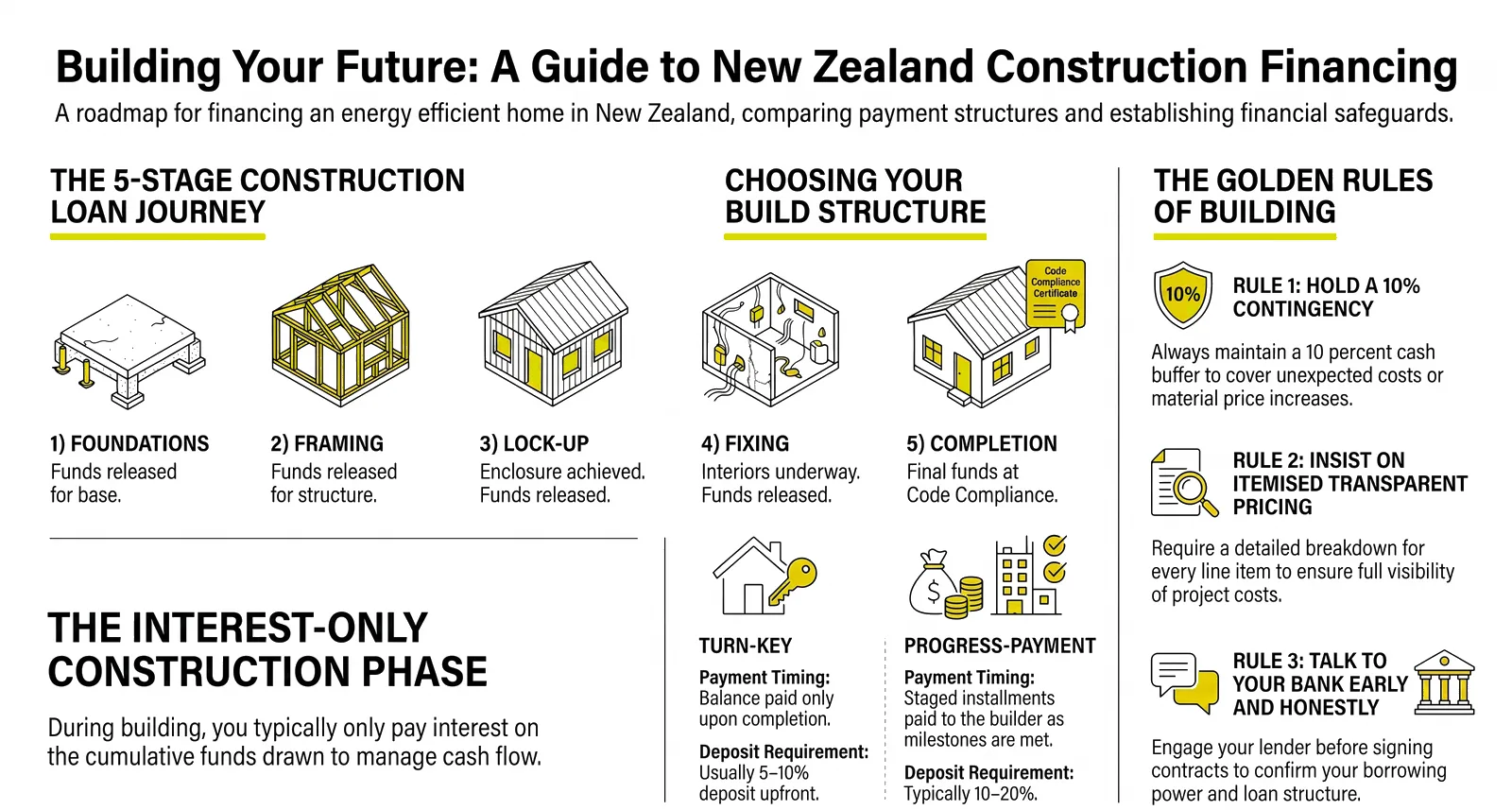
A construction loan releases money in stages as the build progresses, you pay interest only on what has been drawn, and the loan converts to a normal mortgage once the home has its Code Compliance Certificate (Westpac, MoneyHub). Banks prefer fixed-price contracts, but a transparent builder with itemised pricing, recognised guarantees and open reporting can still satisfy a lender, our clients have proven it. The two rules that matter most: talk to your bank early and honestly, and hold a 10 percent contingency no matter what. This guide is general information, not financial advice; your bank or a mortgage adviser should confirm what applies to you.
Key Questions Answered
How does a construction loan work?
The bank approves a total amount but releases it in stages tied to build milestones such as foundations, framing and lock-up. You pay interest only on what has been drawn, and the loan converts to normal repayments once the Code Compliance Certificate is issued (Westpac, MoneyHub).
What is the difference between turn-key and progress payments?
Turn-key means a deposit up front and the balance when the finished home settles, which banks treat much like buying an existing house. Progress-payment contracts fund the build in stages on land you own, with more paperwork and stricter criteria but more control.
Do banks insist on a fixed-price contract?
Most lenders start there. But a fixed price is only as fixed as the plans behind it, and banks can and do lend on transparent open-book builds once they understand the builder: our clients’ banks have researched us, then approved the lending.
How much contingency should I allow?
Ten percent of the build cost, no matter what. A home is a one-off; no plan captures everything. If the contingency would break the budget, the honest answer is that the budget is not ready yet.
Does owning land already help?
Yes. A section with a habitable home on it is easy security for a bank, so lenders are keen to fund a build on land you own. Buying land and building together is more work for them, but fine when the numbers stack up.
In This Guide
- How does a construction loan actually work?
- Turn-key or progress payments: which contract suits you?
- What if the bank wants a fixed price and your builder works open book?
- Why can the bank’s valuation come in under your build cost?
- Where do build budgets and loans actually go wrong?
- Does owning your land already make borrowing easier?
- What is the bottom line?
Key Takeaways
- Construction loans release funds in stages tied to milestones, charge interest only on the drawn amount during the build, and convert to a standard mortgage at Code Compliance (Westpac, MoneyHub).
- Turn-key contracts settle in one payment at completion and are treated by banks much like buying an existing home; progress-payment builds need more documents and a bigger buffer (Capital Advice, First Home Buyers Club).
- A fixed-price contract is only as fixed as the drawings: anything the plans miss can legally come back as an extra, which is why an itemised, transparent price tells you more than a single locked number.
- Hold a 10 percent contingency on every build. A new home is a one-off product, not a production-line purchase, and no set of plans captures everything.
- KiwiSaver first-home withdrawals can be used for a new build, but the First Home Grant was discontinued in May 2024; timing differs between turn-key and progress contracts (Smiths, govt.nz).
How does a construction loan actually work?
A construction loan is a home loan paid out in instalments instead of one lump sum. The bank approves the total, then releases money in stages as the build hits agreed milestones, usually paying your builder directly. During the build you pay interest only, and only on what has been drawn so far, so your payments step up as the home goes up (Westpac, MoneyHub). Once the build is finished and the Code Compliance Certificate is issued, the loan converts to a standard mortgage with principal and interest repayments.
| Typical drawdown stage | What the bank sees |
|---|---|
| Deposit / site start | Signed contract, consent, insurances in place |
| Foundations complete | Slab down, first inspection or invoice evidence |
| Framing / closed in | Structure up, roof on, building wrapped |
| Lock-up and lining | Windows and doors in, interior progressing |
| Completion | Code Compliance Certificate, final valuation, loan converts |
Every bank runs its own version of this ladder, and many verify progress with inspections or a quantity surveyor before releasing each stage. This article is general information, not financial advice: your bank or a mortgage adviser should confirm the details that apply to you.
Turn-key or progress payments: which contract suits you?
The two main ways to buy a new build are a turn-key contract, where you pay a deposit and settle the balance when the finished home is handed over, and a progress-payment build on land you own, funded in stages as above. Banks treat turn-key much like buying an existing home, so approval is simpler and the deposit hurdle can be lower; progress builds involve more documents and a bigger buffer, but give you far more say in what gets built (Capital Advice, First Home Buyers Club).
| Turn-key | Progress payments | |
|---|---|---|
| You pay | Deposit, then balance at settlement | Stages through the build |
| Bank treats it as | Close to an existing-home purchase | A construction loan with drawdowns |
| Interest during build | None on the house (developer carries it) | Interest-only on drawn amounts |
| Design control | Limited | Full |
| Best for | First homes, hands-off buyers | Bespoke and architectural homes |
KiwiSaver first-home withdrawals can go toward a new build under either path, though the timing differs, and the separate First Home Grant was discontinued in May 2024 (Smiths, govt.nz). For a bespoke home on your own section, progress payments are the normal path, and the rest of this guide assumes it.
What if the bank wants a fixed price and your builder works open book?
Most lenders open the conversation with "we need a fixed-price contract from a registered builder". Here is what a decade and a half of building has taught us about that: a fixed price is only as fixed as the drawings behind it. If the plans miss a detail, and one-off homes always hold surprises, the builder can legally come back with extras on top of the "fixed" price. The number on the cover page was never the whole story.
We price differently: open book, with an itemised line-item proposal, monthly budget reports, and every invoice visible. Banks are not used to it, and some of our clients have been told fixed price only. What happened next is worth knowing: their banks researched us, contacted us directly, looked at our history across Nelson and Tasman, and approved the lending. We back that with the paperwork lenders want, insurance certificates and the choice of a Master Builders or Certified Builders guarantee, we can offer both, and when a bank asks for the monthly figures, we send them. Transparency reads as risk to a lender only until they see it working; then it reads as safety.
If you are weighing the contract types themselves, our guide to open-book vs fixed-price contracts goes deeper, and it pairs with engaging your builder early so the price is built on real details, not gaps.
Why can the bank’s valuation come in under your build cost?
Before approving the loan, the bank orders a registered valuation of the finished home. Valuers lean on regional square-metre rates, which work for standard houses but can undervalue a one-off architectural build, and the gap widens in a downturn. We have seen it happen: building through a recession, a client’s bank valued the finished home under its actual build cost because the model said so, lent to the valuation, and the client had to arrange additional funding to bridge the difference.
The postscript matters. We caught up with that client recently, nine years on, and his home has roughly doubled in value since the build. The valuation model was measuring resale on the day against averages; it said nothing about what a well-designed, well-built one-off home is worth over time. The practical lesson: ask your bank early how the valuation will be done, and hold enough buffer that a conservative number does not stall your build.
Where do build budgets and loans actually go wrong?
The most common trap we see is the one that looks safest: signing a fixed-price contract, borrowing to that exact number, and then watching the extras arrive, each one legitimate under the contract because the plans did not identify the detail. With no room in the loan and no buffer in the budget, every extra becomes a crisis. There is a reason people call building one of the most stressful things in life; this pattern is most of that reason.
The fix is not a different contract, it is a buffer. Allow a 10 percent contingency on every build, no matter what the contract says. If the contingency would break the budget, the budget is not ready to build yet, and it is far cheaper to learn that before the slab is poured. Beyond the contingency, the items that commonly live outside the building contract catch people too: driveways and landscaping, service connections, window furnishings, and the interest you pay while the build runs. Our 2026 cost guide breaks down where the money actually goes.
The other half of the fix is early warning. We run a monthly budget meeting with every client and show exactly where the project sits, because money is the biggest stress point in any build. If anything on the horizon worries us, the client hears it from us immediately, with a plan, while the problem is still small. The faster everyone knows, the more options everyone has.
Does owning your land already make borrowing easier?
Yes, noticeably. From a bank’s point of view, a section with a habitable home on it is straightforward security: if everything went wrong, it is easy to sell. So lenders are genuinely keen to fund a good home onto land you already own, which is also why the minor-dwelling equation works so well for families with a spare half-section. Buying the land and funding the build together is more work for the bank and often needs more equity, but when the figures stack up, it proceeds fine.
Whichever position you are in, sequence matters: bank and builder conversations should run together, early, and openly. Honest numbers in both directions is the whole trick; it is how our clients’ lending has been approved even when the contract type was unfamiliar to the lender.
What is the bottom line?
Building a house is not like buying a car. Toyota can price a new car to the cent because they build hundreds of the same one every day. Your home is a one-off that costs twenty times more and has never been built before, so no builder can honestly quote it to the cent, and the ones who claim to are pricing in the gaps somewhere. Finance the build the way it really behaves: staged drawdowns, interest that steps up as you draw, a valuation that may be conservative, and a 10 percent contingency standing behind it all.
Talk to your bank early, choose a builder whose numbers you can see all the way down, and keep both conversations honest. This guide is general information rather than financial advice, so confirm your structure with your bank or adviser. And if you are planning a build in Nelson Tasman, arrange a consultation: we are happy to walk you and your lender through exactly how our open-book process keeps the money side calm.
Frequently Asked Questions
When should I talk to my bank about building?
Before anything is locked in, and at the same time as you start talking to a builder. Be open and honest in both directions. Finance approval can take longer than people expect, and the loan structure can shape the contract type, so the two conversations belong together.
What will the bank want from my builder?
Typically the signed building contract, an itemised price proposal, proof of insurance, and a recognised guarantee. We can offer both Master Builders and Certified Builders guarantees, and banks respond well to that paperwork arriving complete and quickly.
Can I get a construction loan for an open-book or charge-out build?
It is harder than a fixed-price contract, but it happens. Our clients have been told "fixed price only" by a lender, gone back with our itemised proposal and history, and had the bank research us directly and approve the loan. A transparent builder with a long local record changes the conversation.
Why did the bank’s valuation come in lower than my build quote?
Valuers often work from regional square-metre rates, which suit standard homes but undervalue one-off architectural builds, especially in a downturn. If the valuation comes in under cost, the bank may lend less than the build needs, and you cover the gap. It is a valuation of resale, not a verdict on what your home is worth building.
What happens to my payments during the build?
Usually you pay interest only, and only on the amounts drawn down so far, so the cost steps up as the build progresses (MoneyHub). Full principal-and-interest repayments start once the build is complete. Remember to budget for rent or your existing mortgage during the build too.
Is a deposit to the builder safe?
Ask any builder where deposits sit and how they are applied. Ours is held and applied to the final invoice, and clients see a monthly budget report that shows exactly where the project sits, which we will share with the bank when asked. Clear money habits are the best security on both sides.
Research Report: Financing a New Build in NZ
Read Full ReportConstruction loans, drawdowns, contract types and the funding habits that keep a build calm.
How Ecotectural Can Help
Services and systems related to this guide
Planning a build in Nelson Tasman?
Talk to Ecotectural early and keep control of your design and budget from day one.
Arrange a consultation