

Building a House in NZ: Where to Start
The best place to start building a house in New Zealand is not with a plan or a section, it is with a realistic budget and two early conversations, one with your bank and one with a builder. Get those first and the rest falls into a sensible order: understand what you can borrow and spend, engage a builder who can shape the design to that number, assess any land before you buy it, then design, consent and build. The single most common and most expensive mistake is leaving the builder until last, so decisions get locked in and priced afterwards, when changing them is dear. Start with the money and the right people, and a build stays in control from day one.
Key Questions Answered
What is the very first step to building a house?
Set a realistic budget and have two early conversations: one with your bank about what you can borrow, and one with a builder about what that buys. Everything else follows more smoothly once those two numbers are honest and aligned.
What order should things happen in?
Budget and finance, then engage a builder, then assess land, then design to the budget, then consent, then build. The theme is that money and cost knowledge come first, so design decisions are made against a real number.
Should I find land or a design first?
Line up your builder first, then have any section assessed before you buy. Ground conditions and site works are the biggest hidden cost, so a builder’s read on a site can save you from an expensive surprise.
How much contingency should I plan from the start?
Ten percent of the build cost, built into the plan from day one. A one-off home always holds surprises no drawing captures, and if the contingency breaks the budget, the budget is not ready yet.
What is the most common first mistake?
Leaving the builder until the plans are finished. It locks in design and site decisions that nobody priced, so the reconciliation happens on site as variations rather than on paper where it is cheap.
In This Guide
Key Takeaways
- Start with a realistic budget and two early conversations, one with your bank and one with a builder, before choosing a plan or a section.
- Get the order right: finance, then builder, then land assessment, then design to budget, then consent, then build.
- Engaging a builder early is the single biggest thing that keeps design and budget moving together and in control.
- Have any section assessed before you buy; site works and foundations are the biggest hidden cost in a build.
- Build a 10 percent contingency into the plan from the start, and confirm finance early because approval can take longer than expected (Building Act 2004 governs the later consent).
Where do you actually start when building a house?
Not with a plan, and not with a section. You start with a realistic budget and two early conversations: one with your bank about what you can borrow and repay, and one with a builder about what that money actually buys on a real site. Almost everyone begins the other way round, falling for a design or a piece of land first, and it is the reason so many builds start stressed. Get the money and the right people in place first, and every later decision has something solid to stand on.
Those two conversations belong together and belong early, because each shapes the other. Finance approval can take longer than people expect, and what you can borrow shapes what you can build; what a builder knows about real costs shapes whether your plan is affordable before you have paid to draw it. Running them in parallel is how you avoid designing a home the budget was never going to reach. Our guide to financing a new build covers the bank side in detail.
What is the right order to do things in?
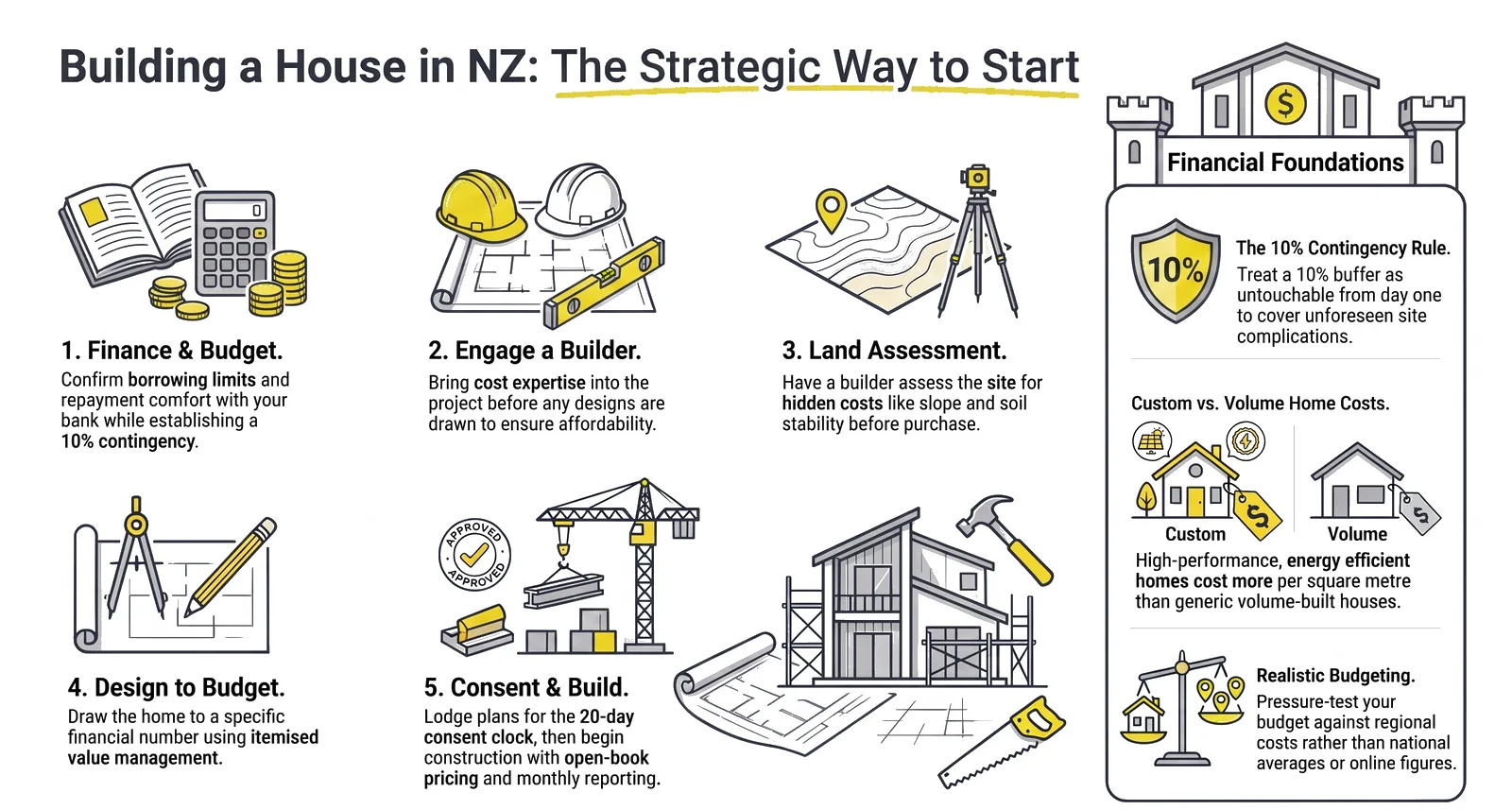
There is a sequence that quietly keeps a build in control, and it puts cost knowledge before commitment at every step: sort finance, engage a builder, assess any land, design to the budget, consent, then build. The thread running through it is simple: no expensive decision gets locked in before someone who knows what it costs has had a say. That is the difference between a budget you steer and a budget that steers you.
| Step | Why it comes here |
|---|---|
| 1. Finance and budget | Know what you can borrow, spend and repay, plus contingency |
| 2. Engage a builder | Bring cost knowledge in before the design is drawn |
| 3. Assess land | Have a builder read any section before you buy |
| 4. Design to budget | Draw the home to a real number, with value management |
| 5. Consent | Lodge complete plans, 20 working day clock (Building Act 2004) |
| 6. Build | One team, open-book pricing, monthly reporting |
The step people most often move to the end is the builder, and it is the most expensive thing to get wrong. Bringing the builder in early is the whole argument of engaging a builder before an architect, and it is what lets the design and the budget move together instead of colliding on site.
How do you set a realistic budget?
Start from what you can borrow and comfortably repay, then pressure-test it against what your kind of home really costs in this region, not against a national square-metre average that was built from volume homes. A custom, high-performance home costs more per square metre than a group-built house, and smaller homes cost more per square metre than larger ones, because the kitchen, bathrooms and services do not shrink with the floor area. A builder can give you a realistic range for your situation far better than any online figure.
Then build in a 10 percent contingency from day one, and treat it as untouchable. A one-off home always turns up something no drawing captured, and the contingency is what keeps that from becoming a crisis. If adding it breaks the budget, the honest conclusion is that the budget is not ready to build yet, which is far cheaper to learn now than after the slab is poured. Our 2026 cost guide sets out where the money actually goes.
Should you find land or design first?
Line up your builder first, then let a section be assessed before you buy it. The temptation is to secure land quickly and design later, but the ground is where the biggest hidden costs live: slope, unstable soil, drainage, access and exposure all land in the foundations and site works, and you cannot fully see them from a listing photo. A builder’s read on a section before you commit can be the difference between a site that builds well and one that quietly eats the budget.
If you already own your land, that is fine, and it often helps your borrowing too, because a bank sees owned land as good security. The point is not to rush either the land or the design, but to get expert eyes on the site early, while you can still walk away or plan around what they find. It is the same principle as choosing the right area in the first place, which we cover in the best areas to build in Nelson Tasman.
What is the bottom line?
Building a house in New Zealand starts with money and people, not plans and pictures. Set a realistic budget, talk to your bank and a builder early and together, and then follow the order that keeps you in control: finance, builder, land assessment, design to budget, consent, build. Keep a 10 percent contingency from the first day, get a builder’s eye on any section before you buy, and never leave the builder until last, because that is where most build stress is born.
If you are at the very start of a build in Nelson Tasman, that is exactly the moment we are most useful. Arrange a consultation and we will help you set a realistic budget, read your site, and get the order right before anything expensive is locked in.
Frequently Asked Questions
Do I need finance sorted before I talk to a builder?
Run both conversations together, early. Your bank tells you what you can borrow; a builder tells you what that actually buys on a real site. Having them in parallel stops you designing a home the budget was never going to reach.
Why involve a builder before the plans are drawn?
So the design is built to a real price from the start. A builder’s cost knowledge and buildability read shape the home while changes are still cheap, on paper, rather than expensive, on site. It is the core idea behind engaging a builder before an architect.
How do I set a realistic budget?
Start from what you can borrow and comfortably repay, keep 10 percent aside as contingency, and get a builder’s guidance on what your kind of home costs in this region rather than relying on national square-metre averages. Our cost guide and financing guide walk through both sides.
Should I buy the land before anything else?
Only with a builder’s eye on it first. A section that looks like a bargain can carry difficult ground, slope or exposure that lands in the foundations, the most expensive place for a surprise. Assess before you commit.
How long does the whole process take?
It varies widely with design and site, but the consent itself runs a twenty working day statutory clock once plans are lodged and you are happy (Building Act 2004). Finance approval and design take their own time, which is exactly why starting early matters.
What if I already have plans or a section?
Then you are further along, and the starting move is simply a proper pricing pass on the plans, or a builder’s assessment of the section, so you know your real number before you go further.
Research Report: Where to Start When Building a House in NZ
Read Full ReportThe starting order that keeps design and budget in control.
Planning a build in Nelson Tasman?
Talk to Ecotectural early and keep control of your design and budget from day one.
Arrange a consultation