

How to Choose an Architectural Home Builder in New Zealand
Choosing an architectural home builder comes down to evidence, not marketing. The right builder for a one-off home can show you finished homes and the owners behind them, prices openly with an itemised proposal you can read, manages the whole project rather than only building, and carries real memberships and guarantees. The red flags are the mirror image: the lowest quote with no workings, vague pricing, no references you can actually call, and claims that cannot be verified. Engage them early, before the design is locked, so their cost knowledge shapes the home, and check everything you can see: homes, clients, pricing and memberships.
Key Questions Answered
What makes an architectural builder different from a volume builder?
An architectural builder designs and builds one-off homes shaped to your site and life, prices them individually, and manages the whole project. A volume builder delivers set plans to a set budget. For a bespoke or high-performance home, you want the former.
What should I look for in a builder?
A visible track record of finished homes and reachable owners, open-book itemised pricing, complete project management by one team, recognised memberships and guarantees, and clear, honest communication from the first meeting.
What are the red flags?
The lowest quote with no itemised workings, vague or verbal pricing, no references you can actually contact, unverifiable claims, and poor communication early, which only gets worse once you are committed.
When should I choose and engage a builder?
Early, before the design is finished. Engaging a builder first lets their cost knowledge and buildability read shape the design while changes are cheap, keeping you in control of both design and budget.
How do I verify a builder?
Visit their completed homes, talk to past clients directly, confirm Master Builders or Certified Builders membership and current insurances, and ask to see an itemised proposal so you can judge how they really price.
In This Guide
Key Takeaways
- An architectural builder designs, prices and builds one-off homes and manages the whole project; a volume builder delivers set plans, so match the builder type to the home you want.
- Green flags: a visible portfolio with reachable owners, open-book itemised pricing, complete project management, recognised memberships and guarantees, and honest early communication.
- Red flags: the lowest quote with no workings, vague pricing, no contactable references, unverifiable claims, and poor communication before you have even signed.
- Engage a builder early, before the design is locked, so their cost knowledge shapes the home and keeps design and budget moving together.
- Verify with evidence you can check: visit homes, call past clients, confirm Master Builders or Certified Builders membership and insurances, and read an itemised proposal.
What makes an architectural builder different?
An architectural builder designs and builds one-off homes, shaped to your site, your sun and the way you live, and manages the whole project end to end. A volume or group builder delivers a home from a set range of plans to a set budget. Both are valid; they are simply different jobs. The moment you want a bespoke or high-performance home, you are choosing from the architectural field, and the way you judge a builder changes accordingly, because you are no longer comparing catalogue prices but craft, pricing honesty and project leadership.
That distinction sets up everything else in this guide. The markers that matter for a one-off home, a real portfolio, open-book pricing, complete project management, are exactly the ones a volume-builder comparison never asks about. If you are still deciding which kind of home you want, our guide to home builders in Nelson Tasman lays out the two camps.
What should you look for in a builder?
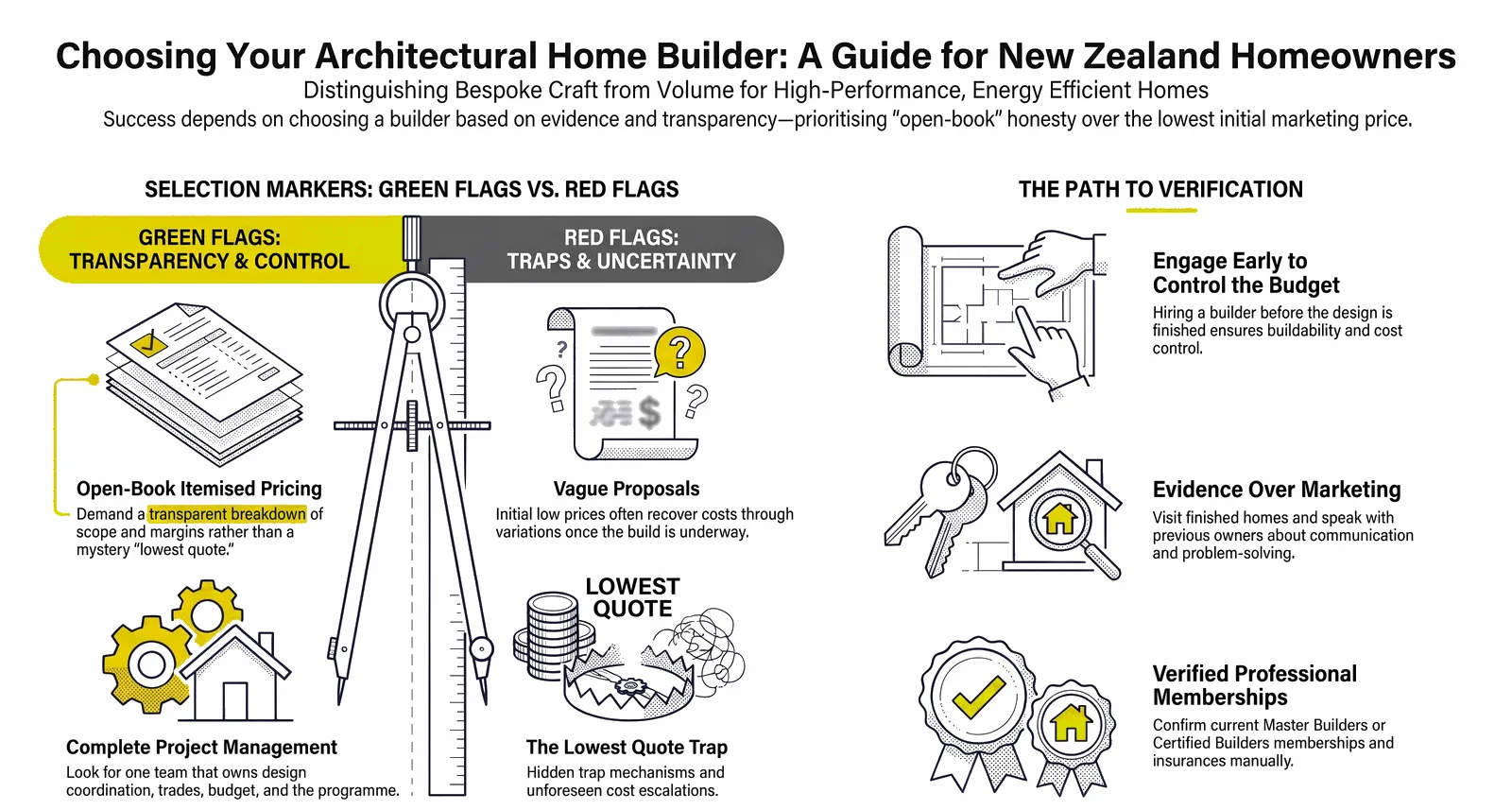
The green flags are the things a good builder is happy to show you, because they have nothing to hide. Look for a visible track record you can inspect, pricing you can read, one team managing the whole build, real memberships and guarantees, and communication that is clear and honest from the first meeting. If a builder is open and organised while they are courting your business, that is usually how they run a build too.
| Green flag | Why it matters |
|---|---|
| Finished homes and reachable owners | Evidence you can stand in and question |
| Open-book itemised pricing | You see scope, allowances and margin, not a mystery number |
| Complete project management | One team owns design coordination, trades, budget and programme |
| Master Builders or Certified Builders | Recognised guarantees and a standard of practice |
| Clear early communication | How they talk now is how they will talk during the build |
None of these is exotic, but together they describe a builder you can trust with the biggest one-off purchase most people ever make. The questions that draw them out are in our questions to ask a builder before you sign.
What are the red flags to avoid?
The red flags are simply the green flags inverted. A quote that is the lowest and the least detailed, so you cannot see what is in it. Pricing that stays vague or verbal, with no itemised proposal. No references you can actually contact, or homes you are not allowed to visit. Claims, including performance claims, that cannot be verified. And poor communication before you have even signed, which never improves once the money is committed and the pressure is on.
Two deserve special mention. The lowest quote is the classic trap: it wins on price and recovers the difference through variations once you are locked in, so the cheapest builder and the blown-out build are often the same one, a pattern we cover in why build costs blow out. And a vague performance claim, building to the Passive House standard with nothing specific behind it, is a red flag rather than a selling point; a credible builder can point to real homes and real numbers (PHINZ).
Why does engaging a builder early matter so much?
Because the greatest value a builder adds happens before the design is finished, not after. Choose a builder late, once the plans are complete, and you have essentially hired a pair of skilled hands to build what someone else drew. Choose one early and you have hired their cost knowledge and buildability to shape the home while every decision is still cheap to change, on paper. The design gets drawn to a real budget from the start, and you stay in control of both.
This is why choosing a builder and engaging them are almost the same decision for a one-off home. The full case is in engaging a builder before an architect, but the short version is this: the earlier the right builder is at the table, the more of your budget and design you keep control of.
How do you verify a builder before you commit?
Do the homework the evidence allows, because for a good builder all of it is available. Visit their completed homes and, just as importantly, talk to the owners directly: ask how the builder handled cost, communication and the inevitable problems, because how a builder behaves when something goes wrong tells you more than a hundred smooth photos. Confirm their Master Builders or Certified Builders membership and current insurances yourself rather than taking them on trust. And ask to see an itemised proposal, so you can judge how they really price rather than how they market.
A builder confident in their work will help you do every one of these things, because each one is a chance to prove themselves. Reluctance to let you check is itself the answer. The whole point of verification is to replace marketing with evidence before you make a decision this large.
What is the bottom line?
Choosing an architectural home builder is an exercise in evidence over marketing. The right builder shows you finished homes and the owners behind them, prices open book, manages the whole project, carries real guarantees, and communicates honestly from the start. The wrong one hides behind the lowest number, vague pricing and claims you cannot check. Engage the right one early, before the design is locked, and verify everything you can see.
If you are choosing a builder for a one-off home in Nelson Tasman, put us on your list and hold us to this standard. Arrange a consultation, come and see our work, talk to our clients, and read exactly how we price. That is the only fair way to choose, and we are happy to be judged on it.
Frequently Asked Questions
Should I just pick the builder with the lowest quote?
No. On a one-off home the lowest number usually means the least was included, not the least it will cost, and the gap returns as variations. Judge builders on itemised proposals and evidence, not on a single headline figure.
How important are Master Builders or Certified Builders memberships?
They matter, because they come with recognised guarantees and a standard of practice, and banks respond well to them. We hold membership of both, so the guarantee choice is yours. Always ask to see current membership and insurance rather than taking it on trust.
Can I trust a builder’s own photos and testimonials?
Use them as a starting point, then verify. The strongest evidence is a home you can stand in and an owner you can question directly about how the builder handled cost, communication and problems. A builder confident in their work will happily arrange both.
What does complete project management actually mean?
One team leading design coordination, subtrades, suppliers, programme and budget, rather than a builder who only builds what someone else drew and manages nothing around it. It is what keeps a complex one-off home from falling through the gaps between trades.
Why does engaging early matter when choosing a builder?
Because the biggest value a builder adds comes before the design is locked. Choose one late and you have hired a pair of hands to build finished plans; choose one early and you have hired cost knowledge and buildability to shape the home affordably from the start.
How do I check a claim like building to the Passive House standard?
Ask for specifics: which homes, what airtightness result, whether performance was tested (PHINZ). A credible builder can point to real projects and real numbers. Vague performance claims with nothing behind them are a red flag, not a selling point.
Research Report: Choosing an Architectural Home Builder
Read Full ReportEvidence over marketing: green flags, red flags and verification.
Planning a build in Nelson Tasman?
Talk to Ecotectural early and keep control of your design and budget from day one.
Arrange a consultation