

The Building Consent Process in Nelson and Tasman, Explained
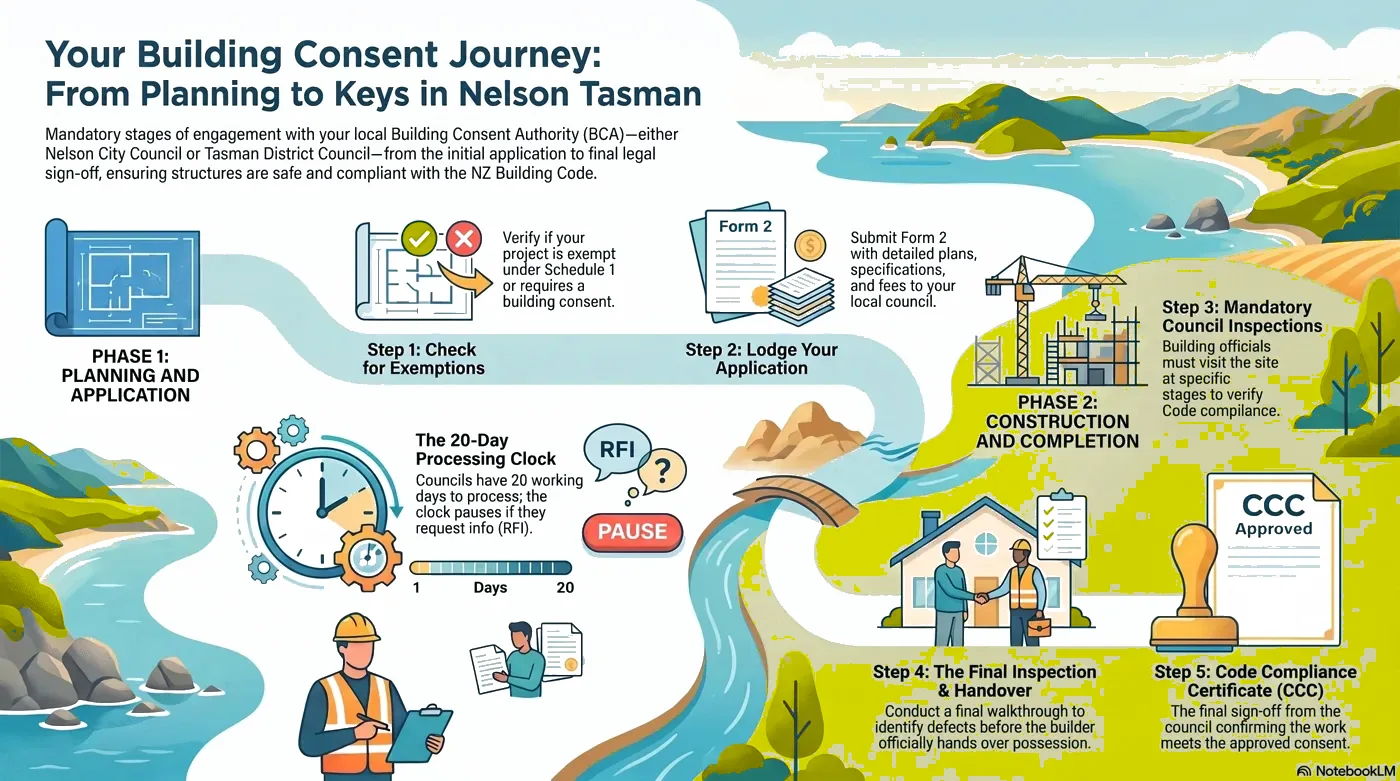
Almost all new home building in the Nelson Tasman region needs a building consent before work starts, granted by the local council: Nelson City Council inside Nelson city, and Tasman District Council across Richmond, Motueka, Mapua, Kaiteriteri and Upper Moutere. Both councils administer the same national process under the Building Act 2004. The council has a statutory 20 working days to process a complete application, that clock pauses if it asks for more information, and the home is inspected during construction before a Code Compliance Certificate confirms the finished build meets the consent.
Key Questions Answered
Do I need a building consent to build a home here?
Yes. Building a new house is building work that needs a consent before it starts (building.govt.nz). Some minor work is exempt under Schedule 1 of the Building Act 2004, but a new home is not.
Which council do I apply to, Tasman District or Nelson City?
It depends on the site. Nelson City Council covers Nelson city; Tasman District Council covers the wider Tasman district, including Richmond, Motueka, Mapua, Kaiteriteri and Upper Moutere. Both run the same Building Act process.
How long does a building consent take?
A council has a statutory 20 working days to process a complete application (Building Act 2004). That clock pauses whenever the council asks for further information, so incomplete applications take longer (OneRoof).
What is a Code Compliance Certificate?
A Code Compliance Certificate (CCC) is the council’s confirmation that the finished building work complies with the consent (building.govt.nz). It is issued after construction and the required inspections.
In This Guide
- Do you need a building consent to build in Nelson Tasman?
- Which council do you apply to: Tasman District or Nelson City?
- What is the building consent process, step by step?
- How long does a building consent take?
- What building work is exempt from consent?
- What happens during construction and at the end?
- How do you keep the consent process smooth?
- What is the bottom line?
Key Takeaways
- A new home in the Nelson Tasman region needs a building consent before work starts, under the Building Act 2004 (building.govt.nz).
- Nelson City Council and Tasman District Council are separate councils, but both administer the same national building consent process.
- A council has a statutory 20 working days to process a complete consent application, and requests for further information pause that clock (Building Act 2004).
- Some low-risk work is exempt under Schedule 1 of the Building Act, but a new dwelling is not (building.govt.nz).
- A Code Compliance Certificate, issued after construction and inspections, confirms the finished work meets the consent (building.govt.nz).
Do you need a building consent to build in Nelson Tasman?
Yes. Building a new home is building work that needs a building consent before it starts, anywhere in New Zealand including the Nelson Tasman region (building.govt.nz). A building consent is your council confirming that your plans meet the Building Code so the work can proceed legally.
It helps to know that a building consent is not the same as a resource consent. A building consent is about how the building is constructed, under the Building Act 2004. A resource consent is about land use and planning, under the Resource Management Act, and some sites need both. This guide covers the building consent, which every new home in the region requires. If you are still at the early stage of planning a build here, our guide to building in Nelson Tasman sets out the wider picture.
Which council do you apply to: Tasman District or Nelson City?
It depends where your section is. Two separate councils serve the region: Nelson City Council processes consents inside Nelson city, and Tasman District Council processes them across the wider Tasman district, including Richmond, Motueka, Mapua, Upper Moutere and Kaiteriteri.
The good news is that the process itself is the same. Both councils act as a building consent authority under the same national Building Act 2004 and Building Code, so the steps, the statutory timeframes and the inspections are consistent across the region. What differs between the two is the practical detail: the application forms, the fees, and the online lodgement portal. You apply to whichever council covers your site, which is one reason a builder who works regularly with both is worth having on your side.
What is the building consent process, step by step?
The building consent process runs in a clear sequence, from confirming you need a consent through to the council signing off the finished home. The table below sets out the stages, who leads each one, and the typical timing.
| Stage | What happens | Who leads | Typical timing |
|---|---|---|---|
| Design and check | Confirm consent is needed and prepare plans to the Building Code | Designer and builder | Before applying |
| PIM (optional) | Get council information about the site, such as hazards and services | Homeowner or designer | With or before the consent |
| Lodge application | Submit plans and documents to Tasman District or Nelson City Council | Builder or designer | Day 0 |
| Processing | Council checks the application against the Building Code | Council | Up to 20 working days (pauses on RFIs) |
| Consent granted | Council issues the building consent | Council | After processing |
| Build and inspections | Construct to the consent; council inspects key stages | Builder and council | Through the build |
| Code Compliance Certificate | Council confirms the finished work meets the consent | Council | After completion |
Most of the time and risk sits in two places: a complete application that the council can process without questions, and well-managed inspections during the build. Both are where an experienced builder earns their keep.
How long does a building consent take?
By law, a council has 20 working days to process a complete building consent application (Building Act 2004). That is the statutory maximum for the council’s assessment, not the whole journey, and it assumes the application is complete when it is lodged.
The reason consents often feel slower is the request for further information, or RFI. When the council needs something clarified or missing, it issues an RFI and the 20 day clock stops until you respond. RFIs are one of the most common causes of delay on a new build (OneRoof). The practical defence is a complete, well-prepared application: thorough plans, the right documentation and clear specifications, lodged once and properly. That is what keeps the clock running and the consent moving.
What building work is exempt from consent?
Some low-risk building work does not need a consent. Schedule 1 of the Building Act 2004 lists the exemptions, which cover things like certain minor repairs, maintenance and small low-risk structures (building.govt.nz). A new dwelling is never exempt.
The rules around smaller buildings have been changing, with central government widening some exemptions over recent years, so it is worth checking the current position rather than relying on an old rule of thumb. The safe approach is simple: if you are unsure whether your project, or part of it, is exempt, ask the council before you build. Getting that wrong is far more expensive to fix later than to confirm up front (building.govt.nz).
What happens during construction and at the end?
Once the consent is granted and building starts, the council stays involved through inspections. It checks key stages of the build, such as foundations, framing, plumbing and drainage, against the approved consent (building.govt.nz). Each inspection has to pass before the work it covers is closed in.
At the end, the council issues a Code Compliance Certificate, or CCC, confirming that the finished building work complies with the building consent. The CCC is the formal sign-off that the home was built as approved, and you should have it before the home is occupied or sold. Missing or delayed inspections are a common reason a CCC is held up, which is another argument for a builder who schedules and manages the council relationship carefully as part of project management.
How do you keep the consent process smooth?
The smoothest consents share three things: complete documentation lodged once, an early-engaged builder who knows the local council, and inspections booked and managed on time. Most delays are avoidable, and they come from incomplete applications and missed inspections rather than slow councils.
Engaging your builder early means the design is prepared with the consent in mind from the start, so the application is right the first time. A local team that works regularly with both Tasman District Council and Nelson City Council knows what each expects and how to keep an application moving. At Ecotectural, managing the consent and the council relationship is part of complete project management, so the consent is one less thing for you to carry.
What is the bottom line?
A new home in the Nelson Tasman region needs a building consent before work starts, under the Building Act 2004 (building.govt.nz). You apply to Nelson City Council or Tasman District Council depending on the site, both run the same national process, the council has a statutory 20 working days to process a complete application, and a Code Compliance Certificate signs off the finished build.
The parts you can control are the ones that matter most: a complete application and well-managed inspections. Both are far easier with a builder engaged early who works with both councils. If you are planning a home anywhere across Nelson and Tasman, the best first step is to arrange a consultation before the design is locked in, so the consent is planned in from day one.
Frequently Asked Questions
What is a building consent?
A building consent is formal approval from your local council, acting as the building consent authority, that your plans comply with the Building Code so building work can proceed legally (building.govt.nz). It is separate from resource consent, which deals with planning and land use.
Do Nelson City Council and Tasman District Council have different processes?
The core process is the same, because both administer the national Building Act 2004 and the Building Code. Application forms, fees and online portals differ between the two councils, so you apply to whichever covers your site.
What is a PIM?
A Project Information Memorandum is council information about your site, such as hazards, zoning and services, that helps plan the build. You can apply for it with or before the building consent (building.govt.nz).
What happens if the council asks for more information?
The council can issue a request for further information (RFI). The statutory processing clock stops until you respond, which is one of the most common reasons consents take longer than expected (OneRoof). Complete, well-prepared applications reduce RFIs.
What inspections happen during the build?
The council inspects key stages of construction, such as foundations, framing and plumbing, against the approved consent. Passing the required inspections is necessary before the Code Compliance Certificate is issued (building.govt.nz).
Can my builder handle the consent process?
Yes. An experienced local builder prepares complete documentation, lodges with the right council, manages RFIs and books inspections. Ecotectural works with both Tasman District Council and Nelson City Council and coordinates consent as part of complete project management.
Research Report: Building Consent in the Nelson Tasman Region
Read Full ReportHow the Building Act 2004 consent process works through Tasman District Council and Nelson City Council, from application to Code Compliance Certificate.
How Ecotectural Can Help
Services and systems related to this guide
Planning a build in Nelson Tasman?
Talk to Ecotectural early and keep control of your design and budget from day one.
Arrange a consultation